Today's
EarthStation1.com 15% Off Commemorative Memorial Title: Glories Of
Medieval Art: The Cloisters DVD, Video Download, USB Drive
Today, November 9, 2025
November 9: Go To An Art Museum Day: --
Remember how excited you were to go on a field trip to the museum
as a kid? The first thing on your mind was probably, "Yeah,
no class!," but a big part of the appeal was the thought of
going on an adventure. And art's all about exploration -- in fact,
that's why we celebrate today! More than 30,000 museums around the
world participate, and each year even has a different theme. So
today, go to a museum and discover something new! And if you can't
go to a museum yourself, you can always explore art online and
read articles by some of the top art journalists. This day invites
everyone to explore the fascinating world of art by visiting
museums. Whether you're a seasoned art lover or just curious, it's
a perfect opportunity to experience the diversity and beauty of
art collections near and far. Museums across the globe
participate, offering a unique glimpse into both historical and
contemporary works. The day emphasizes the joy of learning and the
therapeutic benefits of art. It encourages people to become
tourists in their cities, exploring local museums to discover
something new or to see their surroundings in a different light.
Visiting an art museum can also provide a peaceful escape from
daily routines. It allows visitors to immerse themselves in
creativity and find inspiration or a moment of reflection. Going
to an Art Museum Day is more than just an occasion; it's a chance
to connect with art personally and appreciate its profound impact
on our culture and personal lives. Each visit to a museum offers a
fresh perspective, a new encounter with art that can educate,
inspire, and rejuvenate. Go to an Art Museum Day was born from the
collective enthusiasm of art lovers online. This special day began
as a grassroots movement on social media platforms, where people
shared their museum experiences and encouraged others to explore
the enriching world of art museums. The day quickly caught on,
becoming a favorite way for people to connect with art, learn
about different cultures and historical contexts, and share their
artistic enjoyment with others. The goal of Go to an Art Museum
Day is to promote cultural and artistic education while
recognizing the contributions of artists to society. It has become
a popular occasion for both seasoned art connoisseurs and those
new to art to immerse themselves in the vast and varied
experiences that art museums offer. From classic paintings to
contemporary installations, the day provides an opportunity for
personal inspiration, education, and relaxation in the serene
atmosphere of art galleries. Online communities continue to play a
crucial role in the popularity of Go to an Art Museum Day, using
the internet to extend the reach of art museums to wider audiences
through virtual tours and digital exhibitions. This has allowed
the event to thrive and remain accessible to everyone, regardless
of their physical ability to visit a museum, ensuring that the
beauty and educational value of art is shared globally. On Sale @
15% Off Discount Till Midnight PT!
https://store.earthstation1.com/glories-of-medieval-art-the-cloisters-dvd.html
Today's
EarthStation1.com 15% Off Commemorative Memorial Title: The Berlin
Wall w/Mike Wallace JFK Ich Bin Ein Berliner & More MP4 DVD
Today, November 9, 2025
(#JCKaelin here: #OTD #TDIH #November9: A
portentous day in #GermanHistory: Imperial Germany collapses, the
Kaiser abdicates; the Weimar Republic is proclaimed; Kristallnacht
occurs; Einstein wins the Nobel Prize; and The Berlin Wall falls!)
========= November 9: World Freedom Day: -- November 9, 1989: The
Aftermath Of World War II: The Cold War: The Cold War (1985-1991)
(The End Of The Cold War): The Dissolution Of The Soviet Union:
The Revolutions Of 1989 (The Fall Of Nations, The Autumn Of
Nations, The Fall Of Communism): The Eastern Bloc (The Communist
Bloc, The Socialist Bloc, The Soviet Bloc): The Fall Of East
Germany: The History Of Berlin: The Berlin Wall (German: Berliner
Mauer): The Fall Of The Berlin Wall (German: Mauerfall):: -- On
the 71st anniversary of the fall of Imperial Germany and the
proclamation of the German Republic, East Germany opens
checkpoints in the Berlin Wall after standing for 28 years as a
symbol of the Cold War, allowing its citizens to travel to West
Berlin. The Fall Of The Berlin Wall was a pivotal event in world
history which marked the falling of the Iron Curtain and the start
of the fall of communism in Eastern and Central Europe. The fall
of the inner German border took place shortly afterwards. An end
to the Cold War was declared at the Malta Summit three weeks
later, and the reunification of Germany took place in October the
following year. The 27.9 mile wall had been constructed around
West Berlin in 1961 to prevent East German and East Berliners, who
were in the Soviet-controlled section of Germany, from emigrating
to the west via Allied-controlled (United States, United Kingdom
and France) West Berlin. On Sale @ 15% Off Discount Till Midnight
PT!
https://store.earthstation1.com/the-berlin-wall-documentary-mike-wallace-dvd-mp4-download-usb-driv4.html
Today's
EarthStation1.com 15% Off Commemorative Memorial Title: Napoleon
Bonaparte Documentaries Collection MP4 Video Download DVD
Today, November 9, 2025
November 9, 1799: The Age Of
Enlightenment (The Enlightenment, The Age Of Reason): The Age Of
Revolution: The Atlantic Revolutions: The French Revolution: The
Coup Of 18 Brumaire (The Coup d'Etat Of 18 Brumaire, Coup d'Etat
Du 18 Brumaire) -- Napoleon Bonaparte comes to power as First
Consul of the successor Consulate Government of France, when he
leads the Coup of 18 Brumaire, instantly ending both the Directory
government and The French Revolution, and beginning the process
which ultimately lead to his coronation as Emperor Of The French
five years later. This bloodless coup is so named because it
occurred on 18 Brumaire, Year VIII under the short-lived French
Republican calendar system. On Sale @ 15% Off Discount Till
Midnight PT!
https://store.earthstation1.com/napoleon-bonaparte-documentaries-collection-mp4-video-download-dv4.html
Today's
EarthStation1.com 15% Off Commemorative Memorial Title: The
Historical View A Legacy In Pictures JPG Image Set CD Download USB
Today, November 9, 2025
November 9, 1818: #BOTD: #HBD! Ivan
Turgenev, Russian novelist, short story writer, poet, playwright,
translator and popularizer of Russian literature in the West, one
of the greatest writers of the 19th century (d. September 3, 1883)
is #born Ivan Sergeyevich Turgenev in Oryol (modern-day Oryol
Oblast, Russia) to noble Russian parents Sergei Nikolaevich
Turgenev (1793-1834), a colonel in the Russian cavalry who took
part in the Patriotic War of 1812, and Varvara Petrovna Turgeneva
(nee Lutovinova; 1787-1850). Ivan Turgenev's first major
publication, a short story collection entitled A Sportsman's
Sketches (1852), was a milestone of Russian realism, and his novel
Fathers and Sons (1862) is regarded as one of the major works of
19th-century fiction. Ivan Turgenev died aged 64 of a spinal
abscess, a complication of the metastatic liposarcoma (a soft
tissue cancer), in his house at Bougival near Paris, France. His
remains were taken to Russia and buried in Volkovo Cemetery in St.
Petersburg. Ivan Turgenev's brain was found to be one of the
largest on record for neurotypical individuals (abbreviation of
neurologically typical individuals, autistic people who have
variations in their brains rather than have a disease, a condition
known as neurodiversity, a term coined from the Austism Rights
Movement [The Autism Acceptance Movement), weighing 2,012 g (4 lb
7 oz). On his deathbed, he pleaded with Tolstoy: "My friend,
return to literature!" After this, Tolstoy wrote such works
as The Death of Ivan Ilyich and The Kreutzer Sonata. On Sale @ 15%
Off Discount Till Midnight PT!
https://store.earthstation1.com/the-historical-view-a-legacy-in-pictures-jpg-photo-cd.html
Today's
EarthStation1.com 15% Off Commemorative Memorial Title: Japan: A
Cherry Blossom By Many Other Names MP4 Video Download DVD
Today, November 9, 2025
November 9, 1867: Japan: The History Of
Japan: Imperial Japan (The Empire Of Japan, The Japanese Empire,
Japan): The Boshin War (The Japanese Revolution, The Japanese
Civil War): Bakumatsu (Japanese: "Tent Goverment", The
End Of The Shogunate, The End Of The Tokugawa Shogunate, The End
Of The Edo Shogunate, The End Of The Edo Period): The Meiji
Restoration (Japanese: Meiji Ishin) (The Meiji Renovation, The
Meiji Revolution, The Meiji Reform, The Meiji Renewal): -- The
Tokugawa Shogunate (Japanese: Tokugawa Bakufu), also known as the
Edo shogunate (Japanese: Edo Bakufu), the military government of
Japan during the Edo Period (1603-1868), hands back power to the
Japanese Emperor Mutsuhito, posthumously honored as Emperor Meiji,
effectively marking the beginning of The Meiji Restoration
(Japanese:Meiji Ishin), referred to at the time as the Honorable
Restoration (Japanese: Goishin), which officially began on January
3, 1868. Although there were ruling emperors before the Meiji
Restoration, it restored practical abilities and consolidated the
political system under the Emperor of Japan. The goals of the
restored government were expressed by the new emperor in the
Charter Oath (Japanese: Gokajo No Goseimon, "The Oath In Five
Articles"), promulgated on April 6, 1868 in Kyoto Imperial
Palace. The Oath outlined the main aims and the course of action
to be followed during Emperor Meiji's reign, setting the legal
stage for Japan's modernization. This also set up a process of
urbanization as people of all classes were free to move jobs so
people went to the city for better work. It remained influential,
though less for governing than inspiring, throughout the Meiji era
and into the twentieth century, and it can be considered the first
constitution of modern Japan. The Meiji Restoration led to
enormous changes in Japan's political and social structure and
spanned both the late Edo period and the beginning of the Meiji
era, during which time Japan rapidly industrialized and adopted
Western ideas and production methods. On Sale @ 15% Off Discount
Till Midnight PT!
https://store.earthstation1.com/japan-a-cherry-blossom-by-many-other-names-mp4-video-download-dvd.html
Today's
EarthStation1.com 15% Off Commemorative Memorial Title: Portraits
Of The Presidency: POTUS Documentaries DVD, Download, USB
Today, November 9, 2025
November 9, 1896: #BOTD: #HBD! Nan
Britton, American secretary who was a mistress of Warren G.
Harding, the 29th President of the United States (d. March 21,
1991) is #born Nanna Popham Britton in Marion, Ohio. In 1927, she
revealed that her daughter, Elizabeth, had been fathered by
Harding while he was serving in the United States Senate, one year
before he was elected to the presidency. Her claim was open to
question during her life, but was confirmed by DNA testing in
2015. Nan's father, Dr. Samuel H. Britton, spoke to Harding about
his daughter's infatuation, and Harding met with her, claiming he
told her that some day she would find the man of her dreams. At
the time, Harding was already married and involved in a passionate
affair with Carrie Fulton Phillips, wife of James Phillips,
co-owner of a local department store. After she graduated from
high school in 1914, Britton moved to New York City, to begin a
career as a secretary. However, she claimed she also began an
intimate relationship with Harding. Following Harding's death,
Britton wrote what is considered to be the first kiss-and-tell
book. In The President's Daughter, published in 1927, she claimed
she had been Harding's mistress throughout his presidency and
named him as the father of her daughter, Elizabeth Ann
(1919-2005). One famous passage told of their having sex in a coat
closet in the executive office of the White House. According to
Britton, Harding had promised to support their daughter, but after
his sudden death in 1923, his wife, Florence, refused to honor the
obligation. Britton insisted that she wrote her book to earn money
to support her daughter and to champion the rights of illegitimate
children. She brought a lawsuit (Britton v. Klunk), but she was
unable to provide any concrete evidence and was shaken by the
vicious personal attacks made by Congressman Grant Mouser during
the cross examination, which cost her the case. Britton's
portrayal of Harding and his colloquialisms paints a picture of a
crude womanizer. In his 1931 book Only Yesterday: An Informal
History of the 1920s, Frederick Lewis Allen wrote that on the
testimony of Britton's book, Harding's private life was "one
of cheap sex episodes" and that "one sees with deadly
clarity the essential ordinariness of the man, the commonness of
his 'Gee dearie' and 'Say, you darling'." Britton's book was
among those irreverently reviewed by Dorothy Parker for The New
Yorker magazine as part of her famous Constant Reader column,
under the title "An American DuBarry." In 1964, the
discovery of more than 250 love letters that Harding had written
to Carrie Fulton Phillips between 1909 and 1920 gave further
support to Britton's own claims. Journalist R.W. Apple found
Britton, who had long lived in seclusion, but was refused an
interview. At the time, she was living in the Chicago area. Even
at this time, over a generation later, her daughter and
grandchildren would "occasionally be hounded by hateful
skeptics" with threats and other unwanted attention that
seemed to intensify during presidential elections. In the 1980s,
Britton and her extended family moved to Oregon, where her three
grandchildren currently live. Britton died aged 94 in Sandy,
Oregon, where she had lived during the last years of her life. She
is buried at Pleasant Valley Cemetery in Howard, Ohio. She
insisted until her death that Harding was her daughter's father.
Twenty-four years after her death, in 2015, Ancestry.com confirmed
through DNA testing of descendants of Harding's brother and
Britton's grandchildren that Elizabeth was indeed Harding's
daughter. On Sale @ 15% Off Discount Till Midnight PT!
https://store.earthstation1.com/portraits-of-the-presidency-roosevelt-wilson-hoover-taft-willkie.html
Today's
EarthStation1.com 15% Off Commemorative Memorial Title: White
Cargo (1942) Hedy Lamarr Walter Pidgeon Frank Morgan DVD MP4 USB
Today, November 9, 2025
November 9, 1914: #BOTD: #HBD! Hedy
Lamarr, Austrian-American actress, inventor, sex symbol,
nymphomaniac and beauty (d. January 19, 2000) is #born Hedwig Eva
Maria Kiesler into a Galician Jewish (Galitzianers) in Vienna,
Austria-Hungary. She had an early and brief film career in
Czechoslovakia that included the controversial film Ecstasy (1933:
in which Lamarr is very briefly seen swimming in the nude and
running naked). She fled from her husband, a wealthy Austrian
ammunition manufacturer, and secretly moved to Paris. There, she
met MGM head Louis B. Mayer, who offered her a movie contract in
Hollywood, where she became a film star from the late 1930s to the
1950s. On August 11, 1942, at the beginning of World War II,
Lamarr and composer George Antheil developed a radio guidance
system for Allied torpedoes, which used spread spectrum and
frequency hopping technology to defeat the threat of jamming by
the Axis powers. Although the US Navy did not adopt the technology
until the 1960s, the principles of their work are now incorporated
into modern Wi-Fi, CDMA, and Bluetooth technology, and this work
led to their induction into the National Inventors Hall of Fame in
2014. Hedy Lamarr died in Casselberry, Florida of heart disease,
aged 85. Her son Anthony Loder spread her ashes in Austria's
Vienna Woods in accordance with her last wishes. In 2014 a
memorial to Lamarr was unveiled in Vienna's Central Cemetery. On
Sale @ 15% Off Discount Till Midnight PT!
https://store.earthstation1.com/white-cargo-dvd-hedy-lamarr-walter-pidgeon-frank-morgan.html
Today's
EarthStation1.com 15% Off Commemorative Memorial Title: World War
I: The War Files TV Series DVD, Video Download, USB Drive
Today, November 9, 2025
(#JCKaelin here: #OTD #TDIH #November9: A
portentous day in #GermanHistory: Imperial Germany collapses, the
Kaiser abdicates; the Weimar Republic is proclaimed; Kristallnacht
occurs; Einstein wins the Nobel Prize; and The Berlin Wall falls!)
========= November 9, 1918: The European Civil War: World War I:
The First European War (The European Theater Of World War I): The
Western Front Of World War I: The German Revolution Of 1918-1919:
-- In the final few days of World War I, The Imperial State Of
Germany collapses amid a state of general chaos; Germany becomes a
de facto republic as a result of Kaiser Wilhelm II abdicating the
German and Prussian thrones and fleeing to Holland, with no
agreement made on a succession by his son Crown Prince Wilhelm;
meanwhile, the German Republic, ultimately to become known as the
Weimar Republic and officially as the German Reich, is proclaimed
by MSPD leader Philipp Scheidemann at the Reichstag building in
Berlin, to the fury of Friedrich Ebert, the leader of the Majority
Social Democratic Party of Germany (MSPD) (otherwise known as the
Social Democratic Party of Germany (SPD), not to be confused with
the Independent Social Democratic Party of Germany (USPD), a left
wing breakaway group of the SPD involved in the Kiel Mutiny that
sparked the November Revolution), who thought that the question of
monarchy or republic should be answered by a national assembly.
Two hours later, a "Free Socialist Republic" is
proclaimed, 2 km away, at the Berlin City Palace (German: Berliner
Stadtschloss), also known as the City Palace (German:
Stadtschloss), more properly known as The Berlin Palace (German:
Berliner Schloss) and formally as the Royal Palace (German:
Koenigliches Schloss)) by Karl Liebknecht, co-leader along with
Rosa Luxemburg of the communist Spartakusbund (Spartacus League),
a group of a few hundred supporters of the Russian revolution that
had allied itself with the USPD in 1917. In a legally questionable
act, Imperial Chancellor (Reichskanzler) Prince Max of Baden
transfers his powers to Friedrich Ebert, who, shattered by the
monarchy's fall, reluctantly accepted. In view of the mass support
for more radical reforms among the workers' councils, a coalition
government is formed called "Council of the People's
Deputies" (German: Rat der Volksbeauftragten) was
established, consisting of three MSPD and three USPD members. Led
by Ebert for the MSPD and the jurist and pacifist Hugo Haase for
the USPD, it seeks to act as a provisional cabinet of ministers.
But the power question is nevertheless unanswered. Although the
new government is confirmed by Berlin's Workers And Soldiers
Council, it is opposed by the Spartacus League. Two days later, On
November 11, 1918, an armistice was signed at Compiegne by German
representatives, effectively ending military operations between
the Allies and Germany. It amounted to German capitulation,
without any concessions by the Allies; the naval blockade would
continue until complete peace terms were agreed. The German
Revolution or November Revolution (German: Novemberrevolution) was
a civil conflict in the German Empire at the end of the First
World War that resulted in the replacement of the German federal
constitutional monarchy with a democratic parliamentary republic
that later became known as the Weimar Republic. The revolutionary
period lasted from November 1918 until the adoption in August 1919
of the Weimar Constitution. The causes of the revolution were the
extreme burdens suffered by the population during the four years
of war, the strong impact of the defeat on the German Empire and
the social tensions between the general population and the elite
of aristocrats and bourgeoisie who held power and had just lost
the war. The first acts of revolution were triggered by the
policies of the German Supreme Command of the Army and its lack of
coordination with the Naval Command. In the face of defeat, the
Naval Command insisted on trying to precipitate a climactic battle
with the British Royal Navy by means of its naval order of October
24, 1918. The battle never took place; instead of obeying their
orders to begin preparations to fight the British, German sailors
led a revolt in the naval ports of Wilhelmshaven on October 29,
1918, followed by the Kiel Mutiny in the first days of November.
These disturbances spread the spirit of civil unrest across
Germany, and ultimately led to the proclamation of a republic on
November 9, 1918. Shortly thereafter, Emperor Wilhelm II abdicated
his throne and fled the country. The revolutionaries, inspired by
socialist ideas, did not hand over power to Soviet-style councils
as the Bolsheviks had done in Russia, because the leadership of
the Social Democratic Party of Germany (SPD) opposed their
creation. The SPD opted instead for a national assembly that would
form the basis for a parliamentary system of government. Fearing
an all-out civil war in Germany between militant workers and
reactionary conservatives, the SPD did not plan to strip the old
German upper classes completely of their power and privileges.
Instead, it sought to integrate them into the new social
democratic system. In this endeavour, SPD leftists sought an
alliance with the German Supreme Command. This allowed the army
and the Freikorps (nationalist militias) to quell the communist
Spartacist uprising of 4-15 January 1919 by force. The same
alliance of political forces succeeded in suppressing uprisings of
the left in other parts of Germany, with the result that the
country was completely pacified by late 1919. Elections for the
new Weimar National Assembly were held on January 19, 1919. The
revolution ended on 11 August 1919, when the Weimar Constitution
was adopted. On Sale @ 15% Off Discount Till Midnight PT!
https://store.earthstation1.com/world-war-i-the-war-files-dvd-2-part-documentary-serie2.html
Today's
EarthStation1.com 15% Off Commemorative Memorial Title: The Nobel
Century Nobel Prize History TV Series DVD, MP4, USB Stick
Today, November 9, 2025
(#JCKaelin here: #OTD #TDIH #November9: A
portentous day in #GermanHistory: Imperial Germany collapses, the
Kaiser abdicates; the Weimar Republic is proclaimed; Kristallnacht
occurs; Einstein wins the Nobel Prize; and The Berlin Wall falls!)
========= November 9, 1922: The Nobel Prize: The Nobel Prize In
Physics: The Nobel 1921 Prize In Physics: -- The Nobel Committee
announces that Albert Einstein was selected the winner of the 1921
Nobel Prize in Physics, not for his theory Of telativity, but
rather "for his services to theoretical physics, and
especially for his discovery of the law of the photoelectric
effect", a pivotal step in the development of quantum theory.
While the general theory of relativity was still considered
somewhat controversial, the citation also does not treat even the
cited photoelectric work as an explanation but merely as a
discovery of the law, as the idea of photons was considered
outlandish and did not receive universal acceptance until the 1924
derivation of the Planck spectrum by S. N. Bose. Einstein was
elected a Foreign Member of the Royal Society (ForMemRS) in 1921.
The Nobel Prize in Physics is a yearly award given by the Royal
Swedish Academy of Sciences for those who have made the most
outstanding contributions for mankind in the field of physics. It
is one of the five Nobel Prizes established by the will of Alfred
Nobel in 1895 and awarded since 1901; the others being the Nobel
Prize in Chemistry, Nobel Prize in Literature, Nobel Peace Prize,
and Nobel Prize in Physiology or Medicine. The first Nobel Prize
in Physics was awarded to physicist Wilhelm Roentgen in
recognition of the extraordinary services he rendered by the
discovery of X-rays. This award is administered by the Nobel
Foundation and is widely regarded as the most prestigious award
that a scientist can receive in physics. It is presented in
Stockholm at an annual ceremony on December 10, the anniversary of
Nobel's death. Through 2020, a total of 215 individuals have been
awarded the prize. On Sale @ 15% Off Discount Till Midnight PT!
https://store.earthstation1.com/the-nobel-century-nobel-prize-history-tv-series-dvd-mp4-us4.html
Today's
EarthStation1.com 15% Off Commemorative Memorial Title: John L.
Lewis Documentary Biography DVD, Video Download, USB Drive
Today, November 9, 2025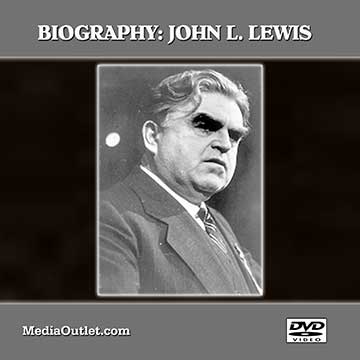
November 9, 1935: Organized Labor: The
Labor Union Movement: The Labor Union Movement In The United
States: The Labor History Of The United States: Labor Unions In
The United States: - The Congress Of Industrial Organizations
(CIO): -- Eight trade unions belonging to the American Federation
Of Labor (AFL), led by John L. Lewis, who was a part of the United
Mine Workers (UMW), merge to found The Congress Of Industrial
Organizations (CIO) in Atlantic City, New Jersey. The CIO was a
federation of unions that organized workers in industrial unions
in the United States and Canada from 1935 to 1955. It was
originally called the Committee for Industrial Organization but
changed its name in 1938 when it broke away from the American
Federation Of Labor. It also changed names because it was not
successful with organizing unskilled workers with the AFL. The CIO
supported Franklin D. Roosevelt and the New Deal Coalition, and
was open to African Americans. Both the CIO and its rival the AFL
grew rapidly during the Great Depression. The rivalry for
dominance was bitter and sometimes violent. In its statement of
purpose, the CIO said it had formed to encourage the AFL to
organize workers in mass production industries along industrial
union lines. The CIO failed to change AFL policy from within. On
September 10, 1936, the AFL suspended all 10 CIO unions (two more
had joined in the previous year). In 1938, these unions formed the
Congress of Industrial Organizations as a rival labor federation.
Section 504 of the Taft-Hartley Act of 1947 required union leaders
to swear that they were not Communists, which many CIO leaders
refused to do; in 1965, the Supreme Court struck down this part of
the law as unconstitutional. In 1955, the CIO rejoined the AFL,
forming the new entity known as the American Federation Of
Labor-Congress of Industrial Organizations (AFL-CIO). On Sale @
15% Off Discount Till Midnight PT!
https://store.earthstation1.com/john-l-lewis-dvd-united-mine-workers-afl-cio.html
Today's
EarthStation1.com 15% Off Commemorative Memorial Title: 11-22-63:
The Day The Nation Cried John F. Kennedy DVD, MP4, USB Drive
Today, November 9, 2025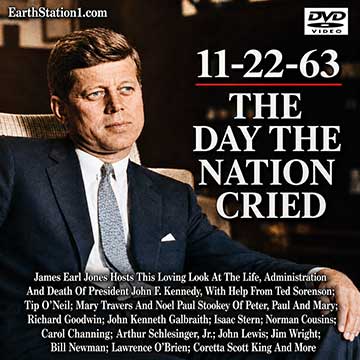
November 9, 1936: #BOTD: #HBD! Mary
Travers, American singer, songwriter and beauty, founding member
of the folk music group Peter, Paul and Mary along with Peter
Yarrow and Paul Stooke (d. September 16, 2009) is #born Mary Allin
Travers in Louisville, Kentucky to Robert Travers and Virginia
Coigney, journalists and active organizers of The Newspaper Guild,
a trade union. Peter, Paul and Mary was one of the most successful
folk music groups of the 1960s. Travers, unlike most folk
musicians of the early 1960s who were a part of the burgeoning
music scene, grew up in New York City's Greenwich Village. A
contralto, Travers released five solo albums in addition to her
work with Peter, Paul and Mary. In 1938, her family moved to
Greenwich Village in New York City. Mary attended the progressive
Little Red School House, where she met musical icons like Pete
Seeger and Paul Robeson. Robeson sang her lullabies. Travers did
not graduate from high school; she left school in the 11th grade
to become a member of the Song Swappers folk group. The Song
Swappers sang backup for Pete Seeger on four reissue albums in
1955, when Folkways Records reissued a collection of Seeger's
pro-union folk songs, "Talking Union". Travers regarded
her singing as a hobby and was shy about it, but was encouraged by
fellow musicians. She also was in the cast of the Broadway show
The Next President. The group Peter, Paul and Mary was formed in
1961, and was an immediate success. They shared a manager, Albert
Grossman, with Bob Dylan. Their success with Dylan's "Don't
Think Twice, It's All Right" helped propel Dylan's
Freewheelin' album into the U.S. Top 30 four months after its
release. An Associated Press obituary noted:" The group's
first album [Peter, Paul and Mary] came out in 1962 and
immediately scored hits with their versions of "If I Had a
Hammer" and "Lemon Tree". The former won them
Grammys for best folk recording and best performance by a vocal
group. Their next album, Moving, included the hit tale of
innocence lost, "Puff, The Magic Dragon", which reached
No. 2 on the [U.S.] charts ... The trio's third album, In the
Wind, featured three songs by the 22-year-old Bob Dylan. "Don't
Think Twice, It's All Right" and "Blowin' in the Wind"
reached the [U.S.] top 10, bringing Dylan's material to a massive
audience; the latter shipped 300,000 copies during one two-week
period. At one point in 1963, three of their albums were in the
top six Billboard best-selling LPs [in the U.S.] as they became
the biggest stars of the folk revival movement. Their version of
[Pete Seeger's] "If I Had a Hammer" became an anthem for
racial equality, as did Bob Dylan's "Blowin' in the Wind",
which they performed at the August 1963 March On Washington."
Peter, Paul and Mary broke up in 1970. The band broke up shortly
after having their biggest UK hit, singer-songwriter John Denver's
poignant ballad "Leaving on a Jet Plane" (originally
titled "Babe I Hate To Go") (UK No. 2, February 1970);
the song made No. 1 on both the U.S. Billboard and Cash Box charts
in December 1969 and was the group's only number one hit. Travers
subsequently pursued a solo career and recorded five albums: Mary
(1971), Morning Glory (1972), All My Choices (1973), Circles
(1974) and It's in Everyone of Us (1978). Peter, Paul and Mary
re-formed in 1978, toured extensively, and issued many new albums.
The group was inducted into the Vocal Group Hall of Fame in 1999.
Travers was married four times. Her first brief union, to John
Filler, produced her older daughter, Erika, in 1960. In 1963, she
married Barry Feinstein, a prominent freelance photographer of
musicians and celebrities. Her younger daughter, Alicia, was born
in 1966, and the couple divorced the following year. In the 1970s,
she was married to Gerald Taylor, publisher of National Lampoon.
Following her marriage to Taylor, Travers had a relationship for
several years with former Watergate prosecutor Richard Ben-Veniste
while raising her daughters in New York. In 1991, she married
restaurateur Ethan Robbins; Travers lived with Robbins in the
small town of Redding, Connecticut, for the remainder of her life.
In 2004, Travers was diagnosed with leukemia. A bone marrow
transplant in 2005 induced a temporary remission, but she died on
September 16, 2009, at Danbury Hospital in Connecticut, from
complications related to the marrow transplant and other
treatments. She was 72 years old. In addition to her husband,
survivors included daughters Erika and Alicia; her sister, the
educator and psychologist Ann Gordon; and two granddaughters,
Virginia and Wylly. She was buried at Umpawaug Cemetery in
Redding, Connecticut. A memorial service for Travers was held on
November 9, 2009, at Riverside Church In New York City. The
four-hour service, on what would have been her seventy-third
birthday, was attended by a capacity crowd. Two of the many
reflections shared at the service speak to the impact of Mary
Travers's work and the significance of her legacy. Feminist Gloria
Steinem commented that with her poise and conviction as a
performer, Ms. Travers "seemed to us to be a free woman, and
that helped us to be free." Folk singer and co-founder of the
Newport Folk Festival, Theodore Bikel, mused on her roles as
political activist and glamorous pop-music touchstone. On Sale @
15% Off Discount Till Midnight PT!
https://store.earthstation1.com/112263-the-day-the-nation-cried-john-f-kennedy--dvd-1122634.html
Today's
EarthStation1.com 15% Off Commemorative Memorial Title: Kristallnacht: 1938 Jewish Pogrom Documentaries MP4 Video Download
DVD
Today, November 9, 2025
Today's
EarthStation1.com 15% Off Commemorative Memorial Title: The Making
Of The President 1960 POTUS Campaign JFK DVD, Download, USB
Today, November 9, 2025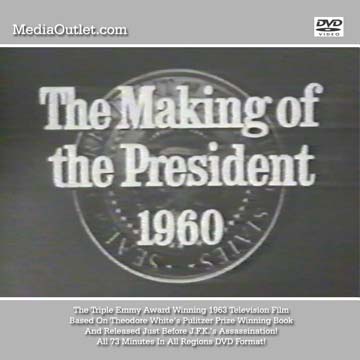
November 9, 1960: Elections: Elections In
The United States: The 1960 United States Presidential Election:
-- In the early hours after midnight, the 1960 United States
Presidential Election results confirm John F. Kennedy is elected
the 35th president of the United States in one of the closest
presidential elections of the 20th century. The election was held
on Tuesday, November 8, 1960. Democratic United States Senator
John F. Kennedy defeated incumbent Vice President Richard Nixon,
the Republican Party nominee. This was the first election in which
fifty states participated and the last in which the District Of
Columbia did not. It was also the first election in which an
incumbent president was ineligible to run for a third term because
of the term limits established by the 22nd Amendment. Nixon faced
little opposition in the Republican race to succeed popular
incumbent Dwight D. Eisenhower. Kennedy, a junior U.S. Senator
from Massachusetts, established himself as the Democratic
front-runner with his strong performance in the 1960 Democratic
primaries, including a key victory in West Virginia over United
States Senator Hubert Humphrey. He defeated Senate Majority Leader
Lyndon B. Johnson on the first presidential ballot of the 1960
Democratic National Convention, and asked Johnson to serve as his
running mate. The issue of the Cold War dominated the election, as
tensions were high between the United States and the Soviet Union.
Kennedy won a 303 to 219 Electoral College victory and is
generally considered to have won the national popular vote by
112,827, a margin of 0.17 percent. Fourteen unpledged electors
from Mississippi and Alabama cast their vote for Senator Harry F.
Byrd, as did a faithless elector from Oklahoma. The 1960
presidential election was the closest election since 1916, and
this closeness can be explained by a number of factors. Kennedy
benefited from the economic recession of 1957-58, which hurt the
standing of the incumbent Republican Party, and he had the
advantage of 17 million more registered Democrats than
Republicans. Furthermore, the new votes that Kennedy, the first
Roman Catholic president, gained among Catholics almost
neutralized the new votes Nixon gained among Protestants.
Kennedy's campaigning skills decisively outmatched Nixon's, who
wasted time and resources campaigning in all fifty states while
Kennedy focused on campaigning in populous swing states. Nixon's
emphasis on his experience carried little weight for most voters.
Kennedy relied on Johnson to hold the South, and used television
effectively. Despite this, Kennedy's popular vote margin was the
narrowest in the 20th century. On November 22, 1963, Kennedy was
assassinated in Dallas, Texas and was succeeded by Johnson. Nixon
would later successfully seek the presidency in 1968 and win
reelection in 1972, but would resign in August 1974 due to the
Watergate scandal; he was succeeded by his Vice President, Gerald
Ford. On Sale @ 15% Off Discount Till Midnight PT!
https://store.earthstation1.com/the-making-of-the-president-1960-dvd-kennedy-nixon-campa1960.html
Today's
EarthStation1.com 15% Off Commemorative Memorial Title: 50 Years
Together: Channel 2 And You WCBS-TV (1991) DVD MP4 USB Drive
Today, November 9, 2025
November 9, 1965: Power Outages
(Powercuts, Power Outs, Power Failures, Power Blackouts, Power
Losses, Blackouts): Power Outages In The United States: The
Northeast Blackout Of 1965: -- At 5:16 p.m., The Great Northeast
Blackout Of 1965 began as a tripped circuit breaker at a power
plant on the Niagara River caused a chain reaction sending power
surges knocking out interconnected power companies down the East
Coast. The blackout affected over 30 million persons, one-sixth of
the entire U.S. population over 80,000 square miles (207,000 km2)
and lasted for up to 13 hours, affecting Connecticut,
Massachusetts, New Hampshire, New Jersey, New York, Rhode Island,
Pennsylvania, and Vermont. Electricity also failed in Ontario and
Quebec. An aircheck of New York City radio station WABC from
November 9, 1965 reveals disc jockey Dan Ingram doing a segment of
his afternoon drive time show, during which he notes that a record
he's playing (Jonathan King's "Everyone's Gone to the Moon")
sounds slow, as do the subsequent jingles played during a
commercial break. Ingram quipped that the King record "was in
the key of R." The station's music playback equipment used
motors that got their speed timing from the frequency of the
powerline, normally 60 Hz. Comparisons of segments of the hit
songs played at the time of the broadcast, minutes before the
blackout happened, in this aircheck, as compared to the same song
recordings played at normal speed reveal that approximately six
minutes before blackout the line frequency was 56 Hz, and just two
minutes before the blackout that frequency dropped to 51 Hz. As Si
Zentner's recording of "(Up a) Lazy River" plays in the
background - again at a slower-than-normal tempo - Ingram mentions
that the lights in the studio are dimming, then suggests that the
electricity itself is slowing down, adding, "I didn't know
that could happen". When the station's Action Central News
report comes on at 5:25 pm ET, the staff remains oblivious to the
impending blackout. The lead story is still Roger Allen LaPorte's
self-immolation at United Nations Headquarters earlier that day to
protest American military involvement in the Vietnam War; a taped
sound bite with the attending physician plays noticeably slower
and lower than usual. The newscast gradually fizzles out as power
is lost by the time newscaster Bill Rice starts delivering the
second story about New Jersey Senator Clifford P. Case's comments
on his home state's recent gubernatorial election. On Sale @ 15%
Off Discount Till Midnight PT!
https://store.earthstation1.com/50-years-together-channel-2-amp-you-dvd-wcbstv-new-y502.html
Today's
EarthStation1.com 15% Off Commemorative Memorial Title: Paul Is
Dead Paul McCartney Death Hoax Radio Shows MP3 CD Download USB
Today, November 9, 2025
November 9, 1966: Conspiracy Theories:
Paul Is Dead: #DOTD (? Nah ;) ) -- The supposed date of Paul
McCartney's death. "Paul Is Dead" is considered an urban
legend and conspiracy theory which alleges that Paul McCartney, of
the English rock band Beatles, died on November 9, 1966 and was
secretly replaced by a look-alike, most often named as Billy
Shears, a character in the Beatles song Sgt. Pepper's Lonely
Hearts Club Band. On October 12, 1969, Disc jockey Russ Gibb broke
the "Paul Is Dead" story when he broadcast "The
Beatles Plot" radio documentary on WKNR-FM Detroit. Rumours
of Paul McCartney's supposed death began circulating around 1967,
but in September 1969, the rumour began spreading across college
campuses in the United States. The rumour was based on perceived
clues found in Beatles songs and album covers. Clue-hunting proved
infectious, and within a few weeks had become an international
phenomenon. According to the theory, McCartney died in a car crash
and, to spare the public from grief, the surviving Beatles
replaced him with the winner of a McCartney look-alike contest,
sometimes identified as "William Campbell" or "Billy
Shears". Afterwards, the band left messages in their music
and album artwork to communicate the truth to their fans. These
include the 1968 song "Glass Onion", in which Lennon
sings "here's another clue for you all / the walrus was
Paul", and the cover photo of their album Abbey Road, in
which McCartney is shown barefoot and walking out of step with his
bandmates. On October 12, 1969, a caller to Detroit radio station
WKNR-FM told disc jockey Russ Gibb about the rumor and its clues.
Gibb and other callers then discussed the rumor on the air for the
next hour. Two days after the WKNR broadcast, The Michigan Daily
published a satirical review of Abbey Road by University of
Michigan student Fred LaBour under the headline "McCartney
Dead; New Evidence Brought to Light". It identified various
clues to McCartney's death on Beatles album covers, including new
clues from the just-released Abbey Road LP. As LaBour had invented
many of the clues, he was astonished when the story was picked up
by newspapers across the United States. Gibb further fueled the
rumor with a special two-hour program on the subject, "The
Beatle Plot", which aired on October 19, 1969, and in the
years since on Detroit radio. Rumours declined after an interview
with McCartney, who had been secluded with his family in Scotland,
was published in Life magazine in November 1969. During the 1970s,
the phenomenon was the subject of analysis in the fields of
sociology, psychology and communications. References to the legend
are still occasionally made in popular culture. McCartney himself
poked fun at it with his 1993 live album, titling it Paul Is Live,
with cover art parodying clues allegedly placed on the cover of
the Beatles' album Abbey Road. In 2009, Time magazine included
"Paul Is Dead" in its feature on ten of "the
world's most enduring conspiracy theories". On Sale @ 15% Off
Discount Till Midnight PT!
https://store.earthstation1.com/paul-is-dead-mp3-cd-paul-mccartney-death-hoax-radio-show3.html
Today's
EarthStation1.com #OnThisDay Commemorative Memorial Title: Voyager
Rendezvous With Neptune Live Carl Sagan Sidney Poitier MP4 DVD
Today, November 9, 2025 ( #JCKaelin here: In the mid 1980s I
lived at a house whose backyard was two lots down and adjacent to
Carl Sagan's boyhood home's backyard in Rahway, New Jersey, and I
believe it shows! :D ) ========= November 9: Carl Sagan Day: --
November 9, 1934: #BOTD: #HBD! Carl Sagan, American astronomer,
astrophysicist, cosmologist, astrobiologist, author, science
popularizer, and science communicator in astronomy and other
natural sciences (d. December 20, 1996) is #born Carl Edward Sagan
in Bensonhurst, Brooklyn into a Reformed Jewish family; his
father, Samuel Sagan, was an immigrant garment worker from
Kamianets-Podilskyi, then in the Russian Empire, in today's
Ukraine; his mother, Rachel Molly Gruber, was a housewife from New
York. Carl Sagan is best known for his work as a science
popularizer and communicator. His best known scientific
contribution is research on extraterrestrial life, including
experimental demonstration of the production of amino acids from
basic chemicals by radiation. Sagan assembled the first physical
messages sent into space: the Pioneer plaque and the Voyager
Golden Record, universal messages that could potentially be
understood by any extraterrestrial intelligence that might find
them. Sagan argued the now accepted hypothesis that the high
surface temperatures of Venus can be attributed to and calculated
using the greenhouse effect. Sagan published more than 600
scientific papers and articles and was author, co-author or editor
of more than 20 books. He wrote many popular science books, such
as The Dragons of Eden, Broca's Brain and Pale Blue Dot, and
narrated and co-wrote the award-winning 1980 television series
Cosmos: A Personal Voyage. The most widely watched series in the
history of American public television, Cosmos has been seen by at
least 500 million people across 60 different countries. The book
Cosmos was published to accompany the series. He also wrote the
science fiction novel Contact, the basis for a 1997 film of the
same name. His papers, containing 595,000 items, are archived at
The Library of Congress. Sagan advocated scientific skeptical
inquiry and the scientific method, pioneered exobiology and
promoted the Search for Extra-Terrestrial Intelligence (SETI). He
spent most of his career as a professor of astronomy at Cornell
University, where he directed the Laboratory for Planetary
Studies. Sagan and his works received numerous awards and honors,
including the NASA Distinguished Public Service Medal, the
National Academy of Sciences Public Welfare Medal, the Pulitzer
Prize for General Non-Fiction for his book The Dragons of Eden,
and, regarding Cosmos: A Personal Voyage, two Emmy Awards, the
Peabody Award and the Hugo Award. He married three times and had
five children. After suffering from myelodysplasia, Sagan died
from pneumonia at the age of 62 at the Fred Hutchinson Cancer
Research Center in Seattle, Washington. His burial took place at
Lake View Cemetery in Ithaca, New York.
https://store.earthstation1.com/voyager-rendezvous-with-neptune-dvd-carl-sagan-sidney-poitier.html
( #JCKaelin here: In the mid 1980s I
lived at a house whose backyard was two lots down and adjacent to
Carl Sagan's boyhood home's backyard in Rahway, New Jersey, and I
believe it shows! :D ) ========= November 9: Carl Sagan Day: --
November 9, 1934: #BOTD: #HBD! Carl Sagan, American astronomer,
astrophysicist, cosmologist, astrobiologist, author, science
popularizer, and science communicator in astronomy and other
natural sciences (d. December 20, 1996) is #born Carl Edward Sagan
in Bensonhurst, Brooklyn into a Reformed Jewish family; his
father, Samuel Sagan, was an immigrant garment worker from
Kamianets-Podilskyi, then in the Russian Empire, in today's
Ukraine; his mother, Rachel Molly Gruber, was a housewife from New
York. Carl Sagan is best known for his work as a science
popularizer and communicator. His best known scientific
contribution is research on extraterrestrial life, including
experimental demonstration of the production of amino acids from
basic chemicals by radiation. Sagan assembled the first physical
messages sent into space: the Pioneer plaque and the Voyager
Golden Record, universal messages that could potentially be
understood by any extraterrestrial intelligence that might find
them. Sagan argued the now accepted hypothesis that the high
surface temperatures of Venus can be attributed to and calculated
using the greenhouse effect. Sagan published more than 600
scientific papers and articles and was author, co-author or editor
of more than 20 books. He wrote many popular science books, such
as The Dragons of Eden, Broca's Brain and Pale Blue Dot, and
narrated and co-wrote the award-winning 1980 television series
Cosmos: A Personal Voyage. The most widely watched series in the
history of American public television, Cosmos has been seen by at
least 500 million people across 60 different countries. The book
Cosmos was published to accompany the series. He also wrote the
science fiction novel Contact, the basis for a 1997 film of the
same name. His papers, containing 595,000 items, are archived at
The Library of Congress. Sagan advocated scientific skeptical
inquiry and the scientific method, pioneered exobiology and
promoted the Search for Extra-Terrestrial Intelligence (SETI). He
spent most of his career as a professor of astronomy at Cornell
University, where he directed the Laboratory for Planetary
Studies. Sagan and his works received numerous awards and honors,
including the NASA Distinguished Public Service Medal, the
National Academy of Sciences Public Welfare Medal, the Pulitzer
Prize for General Non-Fiction for his book The Dragons of Eden,
and, regarding Cosmos: A Personal Voyage, two Emmy Awards, the
Peabody Award and the Hugo Award. He married three times and had
five children. After suffering from myelodysplasia, Sagan died
from pneumonia at the age of 62 at the Fred Hutchinson Cancer
Research Center in Seattle, Washington. His burial took place at
Lake View Cemetery in Ithaca, New York.
https://store.earthstation1.com/voyager-rendezvous-with-neptune-dvd-carl-sagan-sidney-poitier.html
Today's
EarthStation1.com #OnThisDay Commemorative Memorial Title: A
Christmas Carol Fredric March Basil Rathbone DVD Video Download
Today, November 9, 2025November 9: British Pudding Day: -- A day
when pudding lovers can gather and indulge in every kind of
pudding that they ever desired. British Pudding Day celebrates the
origins of British Pudding and how the rich culinary tradition
behind baking puddings is still alive and a favorite of many all
over the world. British puddings are different from American
puddings in that the former comes in both sweet and savory flavors
while the latter is usually a sweet dessert dish. Due to its rich
and complex flavors, British puddings have been a staple cuisine
of its people for many decades. This day is just another
opportunity to give it the love it deserves. British pudding
traces its origins to 1305 where the word 'pudding' was derived
from the Middle English word 'poding,' which meant a 'meat-filled
animal stomach.' The British usage of the word 'pudding,' however,
is closer to the Latin word 'botellus,' which means sausage. The
word 'botellus' gave rise to the word 'boudin' which then came to
mean pudding. Thus, the British pudding is often viewed as a
descendant of the Roman sausage. Many average households in the
16th century featured little ovens in the kitchen. These ovens did
not reach a high temperature. These ovens were useful because they
allowed them to bake a white pudding mixture in pastry over a low
heat for a long time. Baked puddings were born as a result of
this. English puddings in the 17th century were either savory
(meat-based) or sweet (flour, nuts, and sugar). Both flavors
became popular among the English. Traditionally, the puddings were
boiled in special pudding bags. Most traditional British puddings
did not contain meat by the end of the 18th century. In the 19th
century, Bakewell puddings became popular in Britain. These
puddings were descendants of the Ancient Roman Flan. Unlike other
British puddings, the Bakewell pudding had almonds in it. The
Bakewell pudding, unlike other British puddings, had almonds.
Initially, they just used a few drops of almond essence in the
sweet concoction, but over time, they began to add bigger
quantities of ground almonds, resulting in a change in the
consistency of the topping. Bakewell, a town in Derbyshire, is the
source of the pudding's name.
https://store.earthstation1.com/shower-of-stars-a-christmas-carol-frederic-march-basil-rathbone-dvd.html
Today's
EarthStation1.com #OnThisDay Commemorative Memorial Title: Korean
War Films And Documentaries Collection DVD, MP4 Download, USB
Today, November 9, 2025November 9: World Adoption Day: --
Encourages adoptees to share their stories. It's also a day for
adoptive parents to connect with others and reflect upon their
adoption journey. For couples experiencing the pain of
infertility, adoption can be a wonderful way to become parents.
However, there are many other kinds of people who adopt children
each year. Maybe they simply want to provide a home for a child in
need. Or maybe a woman has a medical condition that would make it
dangerous to carry a baby. Others adopt because they are single,
but still wish to have children. On the other side of the
spectrum, there are many reasons children are given up for
adoption. An unwed mother may feel she is too young to take
responsibility for a child. Or, a mother may realize they do not
have enough resources to adequately care for a child. Sadly, many
children become in need of a home when one or both parents die.
While adoption is a beautiful process, it can also be sad to
realize the number of children in need of a home. According to the
United Nations Children's Emergency Fund (UNICEF) more than 150
million children throughout the world are in need of a home. This
number includes the nearly half a million children that are in the
U.S. foster system.
https://store.earthstation1.com/korean-war-films-and-documentaries-dvd.html
Today's
EarthStation1.com #OnThisDay Commemorative Memorial Title: TV
Commercials: The Classics Vol. 9 DVD, MP4 Download, USB Flash
Drive
Today, November 9, 2025November 9: Geriatric Toothfairy Day: --
This day aims to bring awareness to the importance of oral health
for elders living in long-term care and seeks to kick-start the
conversation on how poor dental hygiene affects aging adults'
quality of life, especially when they find themselves in nursing
homes. Showing that we care about their oral wellbeing is
important, as it makes them feel seen and heard and many
sicknesses and systemic diseases are linked to poor dental care
that affects vulnerable communities, like senior citizens. Sonya
and her husband Gerald Dunbar, both valiant Navy Veterans, are the
owners of Mobile Dental Xpress, an entity that prides itself on
providing onsite dental care for senior citizens in nursing homes.
Their efforts focus on helping elders achieve a better quality of
life through improved oral hygiene habits, and on spreading
awareness on the topic. Through her work, Sonya realized that many
aging adults in long-term care facilities cannot address their
oral care and depend on caregivers to do it for them every day. As
a highly-skilled Registered Dental Hygienist with over 25 years of
dental experience, she made it one of her goals to help provide
quality dental services and educate anyone willing to lend an ear
on this issue. So, using her never-ending wits and her 'dental
influencer' powers, in 2020 she created Geriatric Toothfairy Day,
a day set to shine a light on the topic and cast an S.O.S. signal
to help our seniors and prevent them from becoming sick due to
poor oral hygiene. As many long-term care residents do not receive
proper oral care, simple actions like daily tooth brushing and
flossing can make a huge difference. This day brings much-needed
awareness to the oral health of senior citizens in nursing homes,
a topic not talked about often enough in mainstream media.
https://store.earthstation1.com/tv-commercials-the-classics-vol-9-dv9.html
Today's
EarthStation1.com #OnThisDay Commemorative Memorial Title: Making
Sense Of The Sixties TV Series DVD, Video Download, USB Drive
Today, November 9, 2025November 9: Chaos Never Dies Day: --
We're already going a little nuts finding ways to embrace the,
well, chaos of the world we live in. Turns out, there's no real
way to escape the day-to-day crazy that life throws our way.
Rather than run from it, we've found the top ways to temper chaos
and make it fun. Chaos is a state of disorder or confusion, and it
appears in every facet of the human experience since before the
term even came about. In Greek mythology, Khaos is one of the
primordial gods who precedes the universe itself. So, basically,
chaos, and all its confusion and disorder, predates the universe,
making it an integral part of life! While the specific origins of
Chaos Never Dies Day are unknown, what is known is that chaos is
an inevitable part of life. Even as people propagate the idea of
slowing down, taking a break, and taking some time for yourself
(all of which can be a good idea in the right capacity), these
won't stop the inevitable chaos in your life. Sure, the entire
self-care movement, which is based around commercializing
'relaxation' products that help you take a load off, has taken off
in recent years _ but that doesn't mean the chaos stops when you
come out of your face mask and bath-bomb coma! Chaos can mean
different things to different people: for some, it's a
schedule-packed day navigating a large and bustling city. For
others, it's weekly family dinners. Whatever your specific chaos,
the key to enjoying life is embracing the confusion and facing it
head-on. That's where Chaos Never Dies Day comes in - it's
completely dedicated to enjoying the chaos in the world around us!
https://store.earthstation1.com/making-sense-of-the-sixties-tv-documentary-series-6-hour-episode6.html
Today's
EarthStation1.com #OnThisDay Commemorative Memorial Title:
Cambodia: The Khmer Rouge And The Cambodian Genocide DVD MP4 USB
Drive
Today, November 9, 2025November 9: Cambodia Independence Day: --
November 9, 1953: Cambodia gains independence from France. To
celebrate, Cambodia Independence Day commemorates this day
throughout the country. The main venue where the official
celebrations of the ceremony are held happens at the Independence
Monument which is situated in Phnom Penh, the capital of Cambodia.
Every year on this day, a high-ranking official lights a
ceremonial flame at the interior portion of the Independence
Monument, and people deck the monument's stairs with flower
tributes. In the 19th century, the kingdom of Cambodia fell under
the control of the kingdom of Siam and became a vassal state of
the kingdom of Siam. To break free from their domination, King
Norodom signed a treaty with France on August 11, 1863, claiming
that the kingdom is now under France's protection. This pact
resulted in the occupation of Cambodia by the French. Not only did
France seize control of the city, but it also took over Cambodia's
trade relations and military might. During World War II, the
Japanese invaded Cambodia and occupied the country. On March 9,
1945, after a formal request by the Japanese forces, Cambodian
King Norodom Sihanouk proclaimed Cambodia as an independent
Kingdom. The Japanese government also backed Cambodia's
independent status and withdrew its troops. The French, however,
had not given Cambodia full independence. In 1946, Cambodia was
granted self-rule within the French Union. In 1949, the French
took away the protectorate status from Cambodia that the treaty
had established. The French revoked Cambodia's protectorate
status, which had been established under the treaty, in 1949. By
June 1952, King Sihanouk of Cambodia had decided to begin
agitating for Cambodia's official independent status, dismissing
his cabinet, suspending the constitution, and taking charge of the
government as prime minister. In March 1953, King Sihanouk arrived
in France to persuade the French to grant Cambodia complete
independence. His campaign proved to be effective as the French
government announced on July 3, 1953, that it was ready to grant
complete independence to the three states of Cambodia, Vietnam,
and Laos. King Sihanouk reclaimed full control of the military,
the police, foreign and trade relations, the judicial system, and
the country's finance. The French relinquished the authority of
the Cambodian police and military. As a result, King Sihanouk
became a hero to all Cambodians, and his freedom battle is
commemorated every year on Independence Day. He was given the name
"the Father of Independence".
https://store.earthstation1.com/cambodia-the-khmer-rouge-and-the-cambodian-genocide-dvd-mp4-usb-driv4.html
Today's
EarthStation1.com #OnThisDay Commemorative Memorial Title: Pearl
Harbor: Surprise And Remembrance w/ Jason Robards DVD, MP4, USB
Today, November 9, 2025November 9, 1887: Hawaii: The History Of
Hawaii: The United States: The History Of The United States:
United States Expansionism: United States Expansionism In The
Pacific Ocean: American Imperialism: American Imperialism In The
Pacific Ocean: Pearl Harbor: -- The United States Navy takes
possession of Pearl Harbor in Hawaii, having been allowed by The
United States Senate to exercise exclusive rights to the use of
the inlet of Pearl Harbor and to maintain a repair and coaling
station there. These rights were granted to the United States by
The Hawaiian Kingdom when they signed The Reciprocity Treaty Of
1875 as supplemented by Convention on December 6, 1884. This
treaty was ratified in 1887. The desire for the United States to
have a permanent presence in the Pacific both contributed to the
decision, one that was justified by the outbreak of The
Spanish-American War Of 1898. Pearl Harbor is an American lagoon
harbor on the island of Oahu, Hawaii, west of Honolulu. It was
often visited by the naval fleet of the United States, before it
was acquired from the Hawaiian Kingdom by the U.S. with the
signing of the Reciprocity Treaty of 1875. Much of the harbor and
surrounding lands are now a United States Navy deep-water naval
base. It is also the headquarters of the United States Pacific
Fleet. The U.S. government first obtained exclusive use of the
inlet and the right to maintain a repair and coaling station for
ships here in 1887. The surprise attack on the harbor by the
Imperial Japanese Navy on December 7, 1941, led the United States
to declare war on the Empire of Japan, marking the United States'
entry into World War II.
https://store.earthstation1.com/pearl-harbor-surprise-and-remembrance-dvd-jason-robards.html
Today's
EarthStation1.com #OnThisDay Commemorative Memorial Title: La
Belle Epoque 1890-1914 DVD, MP4 Video Download, USB Flash Drive
Today, November 9, 2025November 9, 1841: #BOTD: #HBD! Edward
VII, King Of The United Kingdom of Great Britain and Ireland and
Emperor Of India (and, in an innovation at the time, King Of The
British Dominions), reigns under the name of Edward VII, instead
of Albert Edward, the name his mother had intended for him to use,
declaring that he did not wish to "undervalue the name of
Albert" and diminish the status of his father with whom the
"name should stand alone", Freemason Grand Master of the
United Grand Lodge Of England (d. May 6, 1910) is #born Albert
Edward Saxe-Coburg-Gotha at Buckingham Palace, London, England to
Queen Victoria and Prince Consort Albert Of Saxe-Coburg And Gotha.
The numeral VII was occasionally omitted in Scotland, even by the
national church, in deference to protests that the previous
Edwards were English kings who had "been excluded from
Scotland by battle". J. B. Priestley recalled, "I was
only a child when he succeeded Victoria in 1901, but I can testify
to his extraordinary popularity. He was in fact the most popular
king England had known since the earlier 1660s." Edward
donated his parents' house, Osborne on the Isle of Wight, to the
state and continued to live at Sandringham. He could afford to be
magnanimous; his private secretary, Sir Francis Knollys, claimed
that he was the first heir to succeed to the throne in credit.
Edward's finances had been ably managed by Sir Dighton Probyn,
Comptroller of the Household, and had benefited from advice from
Edward's financier friends, some of whom were Jewish, such as
Ernest Cassel, Maurice de Hirsch and the Rothschild family. At a
time of widespread anti-Semitism, Edward attracted criticism for
openly socialising with Jews. Edward's coronation had originally
been scheduled for June 26, 1902. However, two days before, he was
diagnosed with appendicitis. The disease was generally not treated
operatively. It carried a high mortality rate, but developments in
anaesthesia and antisepsis in the preceding 50 years made
life-saving surgery possible. Sir Frederick Treves, with the
support of Lord Lister, performed a then-radical operation of
draining a pint of pus from the infected abscess through a small
incision (through 4+1/2-inch thickness of belly fat and abdomen
wall); this outcome showed that the cause was not cancer. The next
day, Edward was sitting up in bed, smoking a cigar. Two weeks
later, it was announced that he was out of danger. Treves was
honoured with a baronetcy (which the King had arranged before the
operation) and appendix surgery entered the medical mainstream.
Edward was crowned at Westminster Abbey on August 9, 1902 by the
80-year-old Archbishop of Canterbury, Frederick Temple, who died
only four months later. Edward refurbished the royal palaces,
reintroduced the traditional ceremonies, such as the State Opening
of Parliament, that his mother had foregone, and founded new
honours, such as the Order of Merit, to recognise contributions to
the arts and sciences. In 1902, the Shah of Persia,
Mozzafar-al-Din, visited England expecting to receive the Order Of
The Garter. The King refused to bestow the honour on the Shah
because the order was meant to be in his personal gift and the
Foreign Secretary, Lord Lansdowne, had promised it without his
consent. He also objected to inducting a Muslim into a Christian
order of chivalry. His refusal threatened to damage British
attempts to gain influence in Persia, but Edward resented his
ministers' attempts to reduce his traditional powers. Eventually,
he relented and Britain sent a special embassy to the Shah with a
full Order Of The Garter the following year. Edward VII, King Of
The United Kingdom of Great Britain and Ireland and Emperor Of
India, from January 22 1901 until his death (d. May 6, 1910) was
born Albert Edward Saxe-Coburg-Gotha on November 9, 1841 at
Buckingham Palace, London, England. The second child and eldest
son of Queen Victoria and Prince Albert Of Saxe-Coburg And Gotha,
and nicknamed "Bertie", Edward was related to royalty
throughout Europe. He was Prince Of Wales and heir apparent to the
British throne for almost 60 years. During the long reign of his
mother, he was largely excluded from political influence and came
to personify the fashionable, leisured elite. He travelled
throughout Britain performing ceremonial public duties and
represented Britain on visits abroad. His tours of North America
in 1860 and of the Indian subcontinent in 1875 proved popular
successes, but despite public approval, his reputation as a
playboy prince soured his relationship with his mother. As king,
Edward played a role in the modernisation of the British Home
Fleet and the reorganisation of the British Army after the Second
Boer War of 1899-1902. He re-instituted traditional ceremonies as
public displays and broadened the range of people with whom
royalty socialised. He fostered good relations between Britain and
other European countries, especially France, for which he was
popularly called "Peacemaker", but his relationship with
his nephew, the German Emperor Wilhelm II, was poor. The Edwardian
era, which covered Edward's reign and was named after him,
coincided with the start of a new century and heralded significant
changes in technology and society, including steam turbine
propulsion and the rise of socialism. Edward VII died at 11:45
p.m; a heavy smoker who suffered from chronic bronchitis, he
suffered several heart attacks in a single day, but refused to go
to bed to recuperate, saying, "No, I shall not give in; I
shall go on; I shall work to the end." Fifteen minutes before
Edward's death, between moments of faintness, his son the Prince
Of Wales (shortly to be King George V) told him that his horse,
Witch of the Air, had won at Kempton Park that afternoon. The King
replied, "Yes, I have heard of it. I am very glad": his
final words. He shortly after lost consciousness for the last
time, was put to bed, and died. Alexandra refused to allow
Edward's body to be moved for eight days afterwards, though she
allowed small groups of visitors to enter his room. On May 11, the
late king was dressed in his uniform and placed in a massive oak
coffin, which was moved on May 14 to the throne room, where it was
sealed and lay in state, with a guardsman standing at each corner
of the bier. Despite the time that had elapsed since his death,
Alexandra noted the King's body remained "wonderfully
preserved". On the morning of May 17, the coffin was placed
on a gun carriage and drawn by black horses to Westminster Hall,
with the new king, his family and Edward's favourite dog, Caesar,
walking behind. Following a brief service, the royal family left,
and the hall was opened to the public; over 400,000 people filed
past the coffin over the next two days. As Barbara Tuchman noted
in The Guns of August, his funeral, held on 20 May 1910, marked
"the greatest assemblage of royalty and rank ever gathered in
one place and, of its kind, the last." A royal train conveyed
the King's coffin from London to Windsor Castle, where Edward was
buried at St George's Chapel. Edward was succeeded by his only
surviving son, George V.
https://store.earthstation1.com/la-belle-epoque-18901914-western-high-society-cul18901914.html
Today's
EarthStation1.com #OnThisDay Commemorative Memorial Title: The
Monarchy: British Royal Family History TV Series DVD MP4 USB Drive
Today, November 9, 2025November 9, 1907: The United Kingdom: The
History Of The United Kingdom: The Crown Jewels Of The United
Kingdom (The Crown Jewels Of England): The Cullinan Diamond: --
#BOTD: #HBD! The Cullinan Diamond is presented to King Edward VII
on his birthday, the largest gem-quality rough diamond ever found
on Earth, weighing 3,106 carats (621.20 g / 21.91 oz). The
Cullinan Diamond was discovered at the Premier No.2 mine in
Cullinan, South Africa on January 26, 1905. It was named after
Thomas Cullinan, the owner of the mine. In April 1905, it was put
on sale in London, but despite considerable interest, it was still
unsold after two years. In 1907, the Transvaal Colony government
bought the Cullinan, and Prime Minister Louis Botha presented it
to Edward VII, the British king who reigned over the territory,
and it was cut by Joseph Asscher & Co. in Amsterdam. Cullinan
produced stones of various cuts and sizes, the largest of which is
named Cullinan I, named The Great Star Of Africa by Edward VII,
which at 530.4 carats (106.08 g / 3.742 oz) it is the largest
clear cut diamond in the world. The stone is mounted in the head
of the Sovereign's Sceptre With Cross. The second-largest is
Cullinan II or The Second Star Of Africa, weighing 317.4 carats
(63.48 g / 2.239 oz), mounted in the Imperial State Crown. Both
are part of The Crown Jewels Of The United Kingdom. Seven other
major diamonds, weighing a total of 208.29 carats (41.66 g /
1.47), were privately owned by Elizabeth II, who inherited them
from her grandmother, Queen Mary, in 1953. The Queen also owned
minor brilliants and a set of unpolished fragments.
https://store.earthstation1.com/the-monarchy-3-part-british-royal-family-tv-series-dvd-mp4-u34.html
Today's
EarthStation1.com #OnThisDay Commemorative Memorial Title: The
Longest Hatred: Antisemitism & Jewish Persecution DVD, MP4,
USB
Today, November 9, 2025November 9, 694: Discrimination: Jewish
History: Antisemitism: Councils Of Toledo: The Seventeenth Council
of Toledo: -- King Egica of the Visigoths of Hispania, at the
opening meeting of The Seventeenth Council Of Toledo, sentences
all Jews to slavery, accusing Jews of aiding Muslims in
overthrowing Christian rulers overseas. It was the king's third
council and primarily directed, as was the Sixteenth, against the
Jews, for whom Egica seems to have had a profound distrust and
dislike. The king opened the synod by claiming that he had heard
news of Jews overthrowing their Christian rulers overseas and that
Iberian Jews were conspiring with these cousins to end the
Christian religion once and for all. The council therefore decreed
in its eighth canon that all Jews, except those in Narbonensis,
were to be deprived of their property, which was to be given to
Christian slaves, and enslaved themselves. Their slavekeepers were
chosen by the king and were to be contractually obligated to never
allow the practice of the Jewish religion again. It is, however,
almost certain that, in at least some parts of Spain, these
regulations were not strictly enforced; though in others, they
certainly were. The council tried to protect the life of Egica's
queen and children after his death, knowing the harm which could
befall the royal family during a succession, and the bishops
ordered prayers said for their souls. The council's minutes
ironically remain the best source of information for its period in
Spanish history.
https://store.earthstation1.com/the-longest-hatred-antisemitism-amp-jewish-persecution-dvd-mp3-us3.html
Today's
EarthStation1.com #OnThisDay Commemorative Memorial Title: Exodus:
The Birth Of Israel + Bonus Title DVD, MP4 Download, USB Drive
Today, November 9, 2025November 9, 1952: #DOTD: Chaim Weizmann,
Belarusian-Israeli biochemist, Zionist leader and Israeli
statesman who served as president of the Zionist Organization and
later as the first president of Israel, the most visible Jewish
emissary to the Gentile world (b. November 27, 1874 #dies aged 77
after a long and painful undisclosed illness which for some months
left him entirely incapacitated, at his estate in a Rehovot in the
Central District of Israel, where he received a state burial.
Chaim Weizmann was born Chaim Azriel Weizmann near Pinsk,
Byelorussia. He was elected president of Israel on February 16,
1949, and served until his death nearly three years later.
Weizmann helped bring about the British government's Balfour
Declaration, which called for the establishment of a national home
for Jews in Palestine, and convinced the United States government
to recognize the newly formed state of Israel. Weizmann was also a
biochemist who developed the acetone-butanol-ethanol fermentation
process, which produces acetone through bacterial fermentation.
His acetone production method was of great importance for the
British war industry during World War I. He founded the Weizmann
Institute of Science in Rehovot, Israel, and was instrumental in
the establishment of the Hebrew University of Jerusalem.
https://store.earthstation1.com/exodus-the-birth-of-israel-dvd-history-of-zionism.html
Today's
EarthStation1.com #OnThisDay Commemorative Memorial Title: The
Stasi The East German Secret Police Documentary DVD, Download, USB
Today, November 9, 2025( #JCKaelin here: *Of course* John Le
Carre's fictional spymaster Karla was based on Markus Wolf --
Carre invested much of his time and career giving winks and nods
to his audience that he could and would lie about such things, and
clearly, here he did :) ) ========= November 9, 2006: #DOTD:
Markus Wolf, German intelligence officer, head of the Main
Directorate for Reconnaissance (Hauptverwaltung Aufklarung), the
foreign intelligence division of East Germany's Ministry for State
Security (Ministerium fur Staatssicherheit, abbreviated MfS,
commonly known as the Stasi) (b. January 19, 1923) #dies in his
sleep at his Berlin home aged 83. He is buried in Friedrichsfelde
Central Cemetery in Friedrichsfelde, Lichtenberg, Berlin, Germany.
In 2011 the State Social Court of Berlin-Brandenburg ruled that
his widow, Andrea Wolf, was not entitled to a "compensation
pension" that her husband had been stripped of, which he had
originally received as a "fighter against fascism".
Markus Wolf was born Markus Johannes Wolf in Hechingen, Province
of Hohenzollern (now Baden-Wurttemberg), to a Jewish father and a
non-Jewish German mother. He was the Stasi's number two for 34
years, which spanned most of the Cold War. He is often regarded as
one of the best-known spymasters during the Cold War. In the West
he was known as "the man without a face" due to his
elusiveness. John Le Carre's fictional spymaster Karla, a Russian,
who appears in Tinker, Tailor, Soldier, Spy, The Honourable
Schoolboy, and Smiley's People, was believed by some readers to be
modeled on Wolf. However, the writer has repeatedly denied it, and
did so once again when interviewed on the occasion of Wolf's
death. Le Carre has also stated that it is "sheer nonsense"
to claim that Wolf was the inspiration for the character Fiedler
in The Spy Who Came in from the Cold. Although Fiedler is a German
Jew who spent World War II in exile and then gained a senior
position in East Germany's Intelligence Service, Carre said he had
no idea who Markus Wolf was at the time of the writing of the
book. He added that he considered Wolf to be the moral equivalent
of Albert Speer. He maintained that a character's code name Wolf
in an early draft of the book was a coincidence and that the name
came from the brand of his lawn mower. He renamed the character
after being told that there was an actual Wolf in East German
intelligence. Conversely, Wolf stated that The Spy Who Came In
From the Cold was the only book he read for a period in the early
1960s, and was surprised how accurately it presented the reality
within the East German security services. He wondered if le Carre
had had special information about the situation within the
Ministry of State Security. Based on such evidence, it is most
likely that le Carre was less than truthful about his statements
concerning his writing about Wolf. Wolf appears as a character in
Frederick Forsyth's novel The Deceiver. In the section titled
"Pride and Extreme Prejudice", a KGB officer liaises
with East German intelligence while tracking down a British agent
in East Germany. Forsyth also mentions Wolf in his earlier novel
The Fourth Protocol, describing him, and the East German
intelligence service as a whole, as masters of the false flag
recruitment technique.
https://store.earthstation1.com/stasi-dvd-the-east-german-secret-police-investigative-report.html
Today's
EarthStation1.com #OnThisDay Commemorative Memorial Title: The
Asian Cold War: 1945-1962 MP4 Video Download DVD
Today, November 9, 2025November 9, 1991: #DOTD: Yves Montand,
Italian-French actor, singer and dancer (b. October 13, 1921)
#dies of a heart attack aged 70 on the set of The Island Of
Pachyderms in Senlis, a commune in the northern French department
of Oise, Hautes de France. In an interview, French film director
Jean-Jacques Beineix said, "[H]e died ... on the very last
day, after his very last shot. It was the very last night and we
were doing retakes. He finished what he was doing and then he just
died. And the film tells the story of an old man who dies from a
heart attack, which is the same thing that happened!" Montand
is interred next to his first wife, Simone Signoret, in Pere
Lachaise Cemetery in Paris. Yves Montand was born Ivo Livi in
Monsummano Terme, Italy, to Giovanni Livi, a broom manufacturer,
and Giuseppina Simoni, a devout Catholic, while her husband held
strong Communist beliefs. Montand's family left for France in 1923
because of Italy's Fascist regime. He grew up in Marseille, where,
as a young man, he worked in his sister's beauty salon (Salon de
Coiffure), and later on the docks. He began a career in show
business as a music-hall singer. In 1944, he was discovered by
Edith Piaf in Paris and she made him part of her act. Montand
achieved international recognition as a singer and actor, starring
in many films. His recognizably crooner songs, especially those
about Paris, became instant classics. He was one of the best known
performers at Bruno Coquatrix's Paris Olympia music hall, and
toured with musicians including Didi Duprat. In October 1947, he
sang "Mais qu'est-ce que j'ai ?" (music by Henri Betti
and lyrics by Edith Piaf) at the Theatre de l'Etoile. Betti also
asked him to sing "C'est si bon" but Montand refused.
Following the success of the recording of this song by the Soeurs
Etienne in 1948, he decided to record it. Montand was also very
popular in the Soviet Union and Eastern Europe, where he did a
concert tour in 1956-57; in later life, however, he supported
right-wing causes. During his career, Montand acted in American
motion pictures as well as on Broadway. He was nominated for a
Cesar Award for Best Actor in 1980 for I comme Icare and again in
1984 for Garcon! In 1986, after his international box-office draw
power had fallen off considerably, the 65-year-old Montand gave
one of his best remembered performances, as the scheming uncle in
Jean de Florette, co-starring Gerard Depardieu, and Manon des
Sources (both 1986), co-starring Emmanuelle Beart. The film was a
worldwide critical hit and revived Montand's profile in the US,
where he made an appearance on Late Night with David Letterman. In
1951, he married Simone Signoret, and they co-starred in several
films throughout their careers. The marriage was, by all accounts,
fairly harmonious, lasting until her death in 1985, although
Montand had a number of well-publicized affairs, notably with
Marilyn Monroe, with whom he starred in one of her last films,
Let's Make Love. He was the stepfather to Signoret's daughter from
her prior marriage, Catherine Allegret. Montand's only child,
Valentin, his son by his second wife, Carole Amiel, was born in
1988. In a paternity suit that rocked France, another woman
accused Montand of being the father of her daughter and went to
court to obtain a DNA sample from him. Montand refused, but the
woman persisted even after his death. In a court ruling that made
international headlines, the woman won the right to have Montand
exhumed and a sample taken. The results indicated that he was
probably not the girl's biological father. He supported left-wing
causes during the 1950s and 1960s, and attended Communist
festivals and meetings, but in later life, he supported right-wing
causes. Signoret and Montand had a home in Autheuil-Authouillet,
Normandy, where the main village street is named after him. In
2004, Catherine Allegret, Signoret's daughter from her first
marriage to director Yves Allegret, alleged in her autobiography
Un monde a l'envers (A World Upside Down) that she had been
sexually abused by her stepfather from the age of five; his
behaviour apparently continuing for many years. and that he had a
"more than equivocal attitude to her" as she got older.
However she also claimed to have been reconciled to him in the
latter years of his life.
https://store.earthstation1.com/the-asian-cold-war-19451962-mp4-video-dow194519624.html
Today's
EarthStation1.com #OnThisDay Commemorative Memorial Title: To The
Moon: The Story In Sound Set CD, MP3 Download, USB Flash Drive
Today, November 9, 2025(#JCKaelin here: Since boyhood, I've
loved the Cronkite audio of this launch on "To The Moon: The
Story In Sound Set", which we have put on special for this
listing; it wasn't until CBS released the video to NASA online
that I ever saw it. As I'm familiar with video of subsequent
launches, I know that those launches 1) used cameras that didn't
burn out in the red and yellow color spectrum due to the intensity
of the flames like this one did, and 2) were MUCH FARTHER AWAY SO
THE BUILDING DIDN'T GET BATTERED. This unmanned Apollo 4 launch,
the first Saturn V launch, had an especially close-up view of the
booster launch, a view that was never again repeated in live
television, and is AMAZING - to quote Cronkite from the video, "MY
GOD! OUR BUILDING'S SHAKING HERE! OUR BUILDING'S SHAKING! OH, IT'S
TERRIFIC! OUR BUILDING'S SHAKING... THIS BIG BLAST WINDOW IS
SHAKING AND WE'RE HOLDING IT WITH OUR HANDS... LOOK AT THAT ROCKET
GO! INTO THE CLOUDS AND THREE THOUSAND FEET... OH, IT'S TERRIFIC!
LOOK AT IT GOING! YOU CAN SEE IT! SEE IT?! Part of our roof has
come in here!..." ========= November 9, 1967: Rocket
Launches: Apollo Program: Apollo 4 Mission (SA-501): NASA launches
the first apollo spacecraft, the unmanned Apollo 4 test
spacecraft, atop the Saturn V SA-501 test rocket, the first Saturn
V rocket ever launched which became the launch vehicle that
eventually took astronauts to the Moon, from the Kennedy Space
Center Launch Complex 39 (LC-39) at 12:00:01 UTC. It was recovered
at less than nine hours later at 20:37:00 UTC in the North Pacific
Ocean by the Essex-class aircraft carrier USS Bennington. Apollo 4
was assembled in the Vehicle Assembly Building, and was the first
to be launched from Kennedy Space Center (KSC) in Florida,
ascending from Launch Complex 39, where facilities built specially
for the Saturn V had been constructed. Apollo 4 was an "all-up"
test, meaning all rocket stages and spacecraft were fully
functional on the initial flight, a first for NASA. It was the
first time the S-IC first stage and S-II second stage flew. It
also demonstrated the S-IVB third stage's first in-flight restart.
The mission used a Block I command and service module modified to
test several key Block II revisions, including its heat shield at
simulated lunar-return velocity and angle. The original launch
date was planned for early 1967, but was delayed to November 9
because of a myriad of problems with various elements of the
spacecraft, and difficulties during pre-flight testing. The need
for additional inspections following the Apollo 1 fire, which
killed the first Apollo crew in January 1967, also contributed to
delays. These issues delayed the flight through much of 1967. The
mission splashed down in the Pacific Ocean slightly less than nine
hours after launch, having achieved its objectives. NASA
considered the mission a complete success, proving that the Saturn
V worked, an important step towards achieving the main objective
of landing astronauts on the Moon, and bringing them back safely,
before the end of the 1960s.
https://store.earthstation1.com/to-the-moon-the-story-in-sound-complete-6-album-set-mp3-63.html
Today's
EarthStation1.com #OnThisDay Commemorative Memorial Title: Jean
Shepherd Radio Shows All Known To Exist DVD, MP3 Download, USB
Today, November 9, 2025November 9, 1964: Broadcasting: The
History Of Broadcasting: Radio: The History Of Radio Broadcasting:
Jean Shepherd's "Brits And Americans: Separate Races"
Performance: -- Jean Shepherd broadcasts live from the New York
City Limelight nightclub "Brits And Americans: Separate
Races" upon his return from touring with the Beatles during
the preceding October. Shepherd had been assigned by Time Magazine
to travel with The Beatles, in large part because he was not a fan
of their music. His performance this evening was his first public
comment on his experience, and is full of surprises!
https://store.earthstation1.com/complete-jean-shepherd-radio-and-lp-collection-mp3-dvds-2-dis32.html
Today's
EarthStation1.com #OnThisDay Commemorative Memorial Title: God
Bless You Mr. Chamberlain: Neville Chamberlain DVD, Download, USB
Today, November 9, 2025November 9, 1940: #DOTD: #RIP: Neville
Chamberlain, English businessman, politician and statesman, Prime
Minister of the United Kingdom (b. March 18, 1869) #dies of bowel
cancer in Heckfield, a village in Hampshire, Southern England, at
the age of 71. A funeral service took place at Westminster Abbey,
where his ashes were interred, five days later on Thursday,
November 14; however, due to wartime security concerns, the date
and time were not widely publicised. Chamberlain's former private
secretary John Colville functioned as the service's usher, whilst
both Winston Churchill and Lord Halifax acted as pallbearers.
After cremation, his ashes were interred in the Abbey next to
those of Bonar Law, who served as Prime Minister of the United
Kingdom from October 1922 to May 1923. Churchill eulogised
Chamberlain in the House Of Commons three days after his death:
"Whatever else history may or may not say about these
terrible, tremendous years, we can be sure that Neville
Chamberlain acted with perfect sincerity according to his lights
and strove to the utmost of his capacity and authority, which were
powerful, to save the world from the awful, devastating struggle
in which we are now engaged. This alone will stand him in good
stead as far as what is called the verdict of history is
concerned." Although some Chamberlain supporters found
Churchill's oratory to be faint praise, Churchill added less
publicly, "Whatever shall I do without poor Neville? I was
relying on him to look after the Home Front for me.". Neville
Chamberlain was born Arthur Neville Chamberlain in a house called
Southbourne in the Edgbaston district of Birmingham in the West
Midlands in England. He was a British Conservative Party member
who served as Prime Minister of the United Kingdom from May 1937
to May 1940. Chamberlain is best known for his appeasement foreign
policy, and in particular for his signing of the Munich Agreement
in 1938, conceding the German-speaking Sudetenland region of
Czechoslovakia to Germany. However, when Adolf Hitler later
invaded Poland, the UK declared war on Germany on 3 September
1939, and Chamberlain led Britain through the first eight months
of World War II. After working in business and local government
and after a short spell as Director of National Service in 1916
and 1917, Chamberlain followed his father, Joseph Chamberlain, and
older half-brother, Austen Chamberlain, in becoming a member of
parliament in the 1918 general election at age 49. He declined a
junior ministerial position, remaining a backbencher until 1922.
He was rapidly promoted in 1923 to Minister of Health and then
Chancellor of the Exchequer. After a short Labour-led government,
he returned as Minister of Health, introducing a range of reform
measures from 1924 to 1929. He was appointed Chancellor of the
Exchequer in the National Government in 1931. When Stanley Baldwin
retired in May 1937, Chamberlain took his place as Prime Minister.
His premiership was dominated by the question of policy towards an
increasingly aggressive Germany, and his actions at Munich were
widely popular among Britons at the time. When Hitler continued
his aggression, Chamberlain pledged Britain to defend Poland's
independence if the latter were attacked, an alliance that brought
Britain into war when Germany attacked Poland in 1939. Chamberlain
resigned the premiership on 10 May 1940 after the Allies were
forced to retreat from Norway, as he believed that a government
supported by all parties was essential, and the Labour and Liberal
parties would not join a government headed by him. He was
succeeded by Winston Churchill but remained very well-regarded in
Parliament, especially among Conservatives. Before ill-health
forced him to resign, he was an important member of Churchill's
War Cabinet, heading it in the new premier's absence. Chamberlain
died of cancer six months after leaving the premiership.
Chamberlain's reputation remains controversial among historians,
with the initial high regard for him being entirely eroded by
books such as Guilty Men, published in July 1940, which blamed
Chamberlain and his associates for the Munich accord and for
allegedly failing to prepare the country for war. Most historians
in the generation following Chamberlain's death held similar
views, led by Churchill in The Gathering Storm. Some recent
historians have taken a more favourable perspective of Chamberlain
and his policies, citing government papers released under the
Thirty Year Rule and arguing that going to war with Germany in
1938 would have been disastrous as the UK was not ready.
Nevertheless, Chamberlain is still unfavourably ranked amongst
British Prime Ministers.
https://store.earthstation1.com/god-bless-you-mr-chamberlain-dvd-neville-chamberlain39s-li39.html
Today's
EarthStation1.com #OnThisDay Commemorative Memorial Title: Charles
de Gaulle Documentaries DVD, Video Download, USB Flash Drive
Today, November 9, 2025November 9, 1970: #DOTD: #RIP: Charles de
Gaulle, French general, politician and statesman, 18th President
of France (b. November 22, 1890) #dies suddenly of an aneurysma t
his La Boisserie (the woodland glade) home in
Colombey-les-Deux-Eglises, France around 7:40 p.m., despite
enjoying very robust health his entire life (except for a prostate
operation a few years earlier) less than two weeks before his 80th
birthday; he was watching the television evening news and playing
Solitaire when suddenly he pointed to his head and said, "I
feel a pain right here", then collapsed. His wife called the
doctor and the local priest, but by the time they arrived he had
died. His wife asked that she be allowed to inform her family
before the news was released. She was able to contact her daughter
in Paris quickly, but their son, who was in the navy, was
difficult to track down. President Georges Pompidou was not
informed until 4 AM the next day, and announced the general's
death on television some 18 hours after the event. He simply said,
"Le general de Gaulle est mort; la France est veuve."
("General de Gaulle is dead. France is a widow."). De
Gaulle had made arrangements that insisted his funeral be held at
Colombey, and that no presidents or ministers attend his funeral
only his Compagnons de la Liberation (Companions of the
Liberation, consisting of people, communities and military units
that were awarded the Ordre de la Liberation (Order of
Liberation), a very high honour second only after the Legion
d'Honneur (Legion of Honour),.awarded to heroes of the Liberation
of France during World War II). Despite his wishes, so many
foreign dignitaries wanted to honor de Gaulle that his successor
as president, Georges Pompidou, was forced to arrange a separate
memorial service at Notre-Dame Cathedral that was held at the same
time as his actual funeral. His funeral was held on November 12,
1970, and was the biggest such event in French history, with
hundreds of thousands of French people, many carrying blankets and
picnic baskets, and thousands of cars parked in the roads and
fields along the routes to both venues. On the day of the funeral,
there was national mourning, many entertainment and cultural
events were canceled, and schools and offices were closed.
Thousands of guests attended the event, included De Gaulle's
successor Georges Pompidou, U.S. president Richard Nixon, British
prime minister Edward Heath, UN secretary-general U Thant, Soviet
statesman Nikolai Podgorny, Italian president Giuseppe Saragat,
West German chancellor Willy Brandt and Queen Juliana of the
Netherlands. Special trains were sent to bring extra mourners to
the region, and the crowd was packed so tightly that those who
fainted had to be passed overhead toward first-aid stations at the
rear. The General was conveyed to the church of
Colombey-Les-Deux-Eglises in Champagne-Ardenne, France on an
armoured reconnaissance vehicle and carried to his grave, next to
his daughter Anne, by eight young men of Colombey. As he was
lowered into the churchyard burial ground, the bells of all the
churches in France tolled, starting from Notre Dame and spreading
out from there. De Gaulle specified that his tombstone bear the
simple inscription of his name and his years of birth and death.
Therefore, it simply states, "Charles de Gaulle, 1890-1970".
At the service, President Pompidou said, "de Gaulle gave
France her governing institutions, her independence and her place
in the world." Andre Malraux, the writer and intellectual who
served as his Minister of Culture, called him "a man of the
day before yesterday and the day after tomorrow." De Gaulle's
family turned the La Boisserie residence into a foundation. It
currently houses the Charles de Gaulle Museum. He was born Charles
Andre Joseph Marie de Gaulle in Lille in the Nord department in
Hauts-de-France region of France bordering Belgium. de Gaulle was
the leader of Free France (1940-1944) and the head of the
Provisional Government of the French Republic (1944-1946). In
1958, he founded the Fifth Republic and was elected as the
President of France, a position he held until his resignation in
1969. He was the dominant figure of France during the Cold War era
and his memory continues to influence French politics. He was a
decorated officer of the First World War, wounded several times,
and later taken prisoner at Verdun. During the interwar period, he
advocated mobile armoured divisions. During the German invasion of
May 1940, he led an armoured division which counterattacked the
invaders; he was then appointed Under-Secretary for War. Refusing
to accept his government's armistice with Nazi Germany, de Gaulle
exhorted the French population to resist occupation and to
continue the fight in his Appeal of 18 June. He led a government
in exile and the Free French Forces against the Axis. Despite
frosty relations with Britain and especially the United States, he
emerged as the undisputed leader of the French resistance. He
became Head of the Provisional Government of the French Republic
in June 1944, the interim government of France following its
Liberation. As early as 1944, de Gaulle introduced a dirigiste
economic policy, which included substantial state-directed control
over a capitalist economy which was followed by 30 years of
unprecedented growth, known as Les Trente Glorieuses ("The
Glorious Thirty"). Frustrated by the return of petty
partisanship in the new Fourth Republic, he resigned in early 1946
but continued to be politically active as founder of the
Rassemblement du Peuple Francais (RPF) party, which means "Rally
of the French People." He retired in the early 1950s and
wrote a book about his experience in the war titled War Memoirs,
which quickly became a classic of modern French literature. When
the Algerian War was ripping apart the unstable Fourth Republic,
the National Assembly brought him back to power during the May
1958 crisis. He founded the Fifth Republic with a strong
presidency, and he was elected to continue in that role. He
managed to keep France together while taking steps to end the war,
much to the anger of the Pieds-Noirs (Frenchmen settled in
Algeria) and the military; both previously had supported his
return to power to maintain colonial rule. He granted independence
to Algeria and progressively to other French colonies. In the
context of the Cold War, de Gaulle initiated his "Politics of
Grandeur," asserting that France as a major power should not
rely on other countries, such as the US, for its national security
and prosperity. To this end, de Gaulle pursued a policy of
"national independence" which led him to withdraw from
NATO's military integrated command and to launch an independent
nuclear development program that made France the fourth nuclear
power. He restored cordial Franco-German relations to create a
European counterweight between the Anglo-American and Soviet
spheres of influence through the signing of the Elysee Treaty on
January 22, 1963. However, he opposed any development of a
supranational Europe, favouring a Europe of sovereign nations. De
Gaulle openly criticised the US intervention in Vietnam and the
"exorbitant privilege" of the US dollar. In his later
years, his support for an independent Quebec and his two vetoes
against Britain's entry into the European Economic Community
generated considerable controversy. Although re-elected President
in 1965, in May 1968 he appeared likely to lose power amid
widespread protests by students and workers, but survived the
crisis with backing from the Army and won an election with an
increased majority in the Assembly. De Gaulle resigned in 1969
after losing a referendum in which he proposed more
decentralization. He died a year later at his residence in
Colombey-les-Deux-Eglises, leaving his Presidential memoirs
unfinished. Many French political parties and figures claim the
Gaullist legacy. De Gaulle was ranked as "Le Plus Grand
Francais de tous les temps" (the Greatest Frenchman of All
Time) by the French magazine L'OBS.
https://store.earthstation1.com/charles-de-gaulle-dvd-general-president-dual-layer-wwii.html
Today's
EarthStation1.com #OnThisDay Commemorative Memorial Title: Between
The Wars TV Documentary Series DVD, Video Download, USB Drive
Today, November 9, 2025November 9, 1924: #DOTD: Henry Cabot
Lodge, American Republican Congressman and historian from
Massachusetts (b. May 12, 1850) #dies at the age of 74 of a severe
stroke while recovering in the hospital from surgery for
gallstones four days earlier. He is buried in the Mount Auburn
Cemetery in Cambridge, Massachusetts. Henry Cabot Lodge was born
in Beverly, Massachusetts into the Boston Brahmin family of John
Ellerton Lodge of the the Boston Brahmin Lodge family and Anna
Cabot of the Boston Brahmin Cabot family. Through his mother he
was a great-grandson of George Cabot (1751 or 1752 - April 18,
1823), American merchant, seaman, and politician from
Massachusetts who represented the state as a U.S. Senator, a major
figure in the Hamiltonian faction of the Federalist Party and was
a vocal supporter of war with Revolutionary France, and was the
presiding officer of the infamous Hartford Convention, which
discussed removing the three-fifths compromise and requiring a
two-thirds majority in Congress for the admission of new states,
declarations of war, and creating laws restricting trade, and
discussed their grievances with the Louisiana Purchase and the
Embargo of 1807, all of which were contributing factors to the
downfall of the Federalist Party. Henry Cabot Lodge was also a
cousin of American polymath Charles Peirce, scientist,
mathematician, logician, and philosopher known as "The Father
Of Pragmatism", who according to philosopher Paul Weiss was
"the most original and versatile of America's philosophers
and America's greatest logician", and of whom Bertrand
Russell wrote "he was one of the most original minds of the
later nineteenth century and certainly the greatest American
thinker ever". Henry Cabot Lodge grew up on Boston's Beacon
Hill and spent part of his childhood in Nahant, Massachusetts,
where he witnessed the 1860 kidnapping of a classmate and gave
testimony leading to the arrest and conviction of the kidnappers.
When the Civil War broke out in 1861, Lodge's father wanted to
ride into battle at the head of a cavalry regiment he had
personally put together, but his father missed the chance,
possibly due to a bad knee from a riding injury, and in September
1862, Lodge's father suddenly died. In 1874, he graduated from
Harvard Law School, and was admitted to the bar in 1875,
practicing at the Boston firm now known as Ropes & Gray. A
member of the prominent Lodge family, he received his PhD in
history from Harvard University. He is best known for his
positions on foreign policy, especially his battle with President
Woodrow Wilson in 1919 over the Treaty Of Versailles. The failure
of that treaty ensured that the United States never joined the
League Of Nations. Born in Beverly, Massachusetts, Lodge won
election to the Massachusetts House of Representatives after
graduating from Harvard. He and his close friend, Theodore
Roosevelt, opposed James G. Blaine's nomination at the 1884
Republican National Convention, but supported Blaine in the
general election against Grover Cleveland. Lodge was elected to
the United States House Of Representatives in 1886 before joining
the United States Senate in 1893. In the Senate, he sponsored the
unsuccessful Lodge Bill, which sought to protect the voting rights
of African Americans. He supported the Spanish-American War and
called for the annexation of the Philippines after the war. He
also supported immigration restrictions, becoming a member of the
Immigration Restriction League and influencing the Immigration Act
of 1917. Lodge served as Chairman of the 1900 and 1908 Republican
National Conventions. A member of the conservative wing of the
Republican Party, Lodge opposed Roosevelt's third party bid for
president in 1912, but the two remained close friends. During the
presidency of Woodrow Wilson, Lodge advocated entrance into World
War I on the side of the Entente Powers. He became Chairman of the
Senate Republican Conference and Chairman of the Senate Committee
on Foreign Relations, emerging as the leader of the Senate
Republicans. He led the opposition to Wilson's Treaty Of
Versailles, proposing twelve reservations to the treaty. He most
strongly objected to the provision of the treaty that required all
nations to repel aggression, fearing that this would erode
Congressional powers and commit the U.S. to burdensome
obligations. Lodge prevailed in the treaty battle and Lodge's
objections would influence the United Nations, the successor to
the League Of Nations. After the war, Lodge participated in the
creation of the Washington Naval Treaty, which sought to prevent a
naval arms race. He remained in the Senate until his death in
1924.
https://store.earthstation1.com/between-the-wars-dvd-set-all-16-tv-shows-4-discs164.html
Today's
EarthStation1.com #OnThisDay Commemorative Memorial Title: Winston
Churchill: The Wilderness Years TV Series DVD, MP4, USB Drive
Today, November 9, 2025November 9, 1937: #DOTD: #RIP: Ramsay
MacDonald, Scottish journalist, orator, pamphleteer, author and
British politician, first Labour Party member to become Prime
Minister of the United Kingdom, leading minority Labour
governments for nine months in 1924 and then from 1929-31 (b.
October 12, 1866) #dies on board the liner MV Reina del Pacifico
at sea at the age of 71 with his youngest daughter Sheila at his
side. His funeral was in Westminster Abbey on November 26. After
cremation, his ashes were buried alongside his wife Margaret at
Spynie in his native Morayshire. Ramsay MacDonald was born James
McDonald at Gregory Place, Lossiemouth, Moray, Scotland, the
illegitimate son of John MacDonald, a farm labourer, and Anne
Ramsay, a housemaid. Registered at birth as James McDonald (sic)
Ramsay, he was known as Jaimie MacDonald. Illegitimacy could be a
serious handicap in 19th-century Presbyterian Scotland, but in the
north and northeast farming communities this was less of a
problem; in 1868 a report of the Royal Commission on the
Employment of Children, Young Persons and Women in Agriculture
noted that the illegitimacy rate was around 15% -- nearly every
sixth person was born out of wedlock. Ramsay MacDonald headed a
National Government dominated by the Conservative Party from 1931
to 1935 with the support of only a few Labour members. MacDonald
was expelled from the Labour Party as a result. MacDonald, along
with Keir Hardie and Arthur Henderson, was one of the three
principal founders of the Labour Party in 1900. He was chairman of
the Labour MPs before 1914 and, after an eclipse in his career
caused by his opposition to the First World War, he was Leader of
the Labour Party from 1922. The second Labour Government (1929-31)
was dominated by the Great Depression. He formed the National
Government to carry out spending cuts to defend the gold standard,
but it had to be abandoned after the Invergordon Mutiny, an
industrial action by around 1,000 sailors in the British Atlantic
Fleet that took place on September 15-16 1931, when ships of the
Royal Navy at Invergordon were in open mutiny, in one of the few
military strikes in British history. The mutiny caused a panic on
the London Stock Exchange and a run on the pound, bringing
Britain's economic troubles to a head and forcing it off the Gold
Standard on September 21. 1931. MacDonald called a general
election in 1931 seeking a "doctor's mandate" to fix the
economy. The National coalition won an overwhelming landslide and
the Labour Party was reduced to a rump of around 50 seats in the
House Of Commons. His health deteriorated and he stood down as
Prime Minister in 1935, remaining as Lord President of the Council
until retiring in 1937. He died later that year. MacDonald's
speeches, pamphlets and books made him an important theoretician.
Historian John Shepherd states that "MacDonald's natural
gifts of an imposing presence, handsome features and a persuasive
oratory delivered with an arresting Highlands accent made him the
iconic Labour leader". After 1931, MacDonald was repeatedly
and bitterly denounced by the Labour movement as a traitor to its
cause. Since the 1960s, historians have defended his reputation,
emphasising his earlier role in building up the Labour Party,
dealing with the Great Depression, and as a putative forerunner of
the political realignments of the 1990s and 2000s.
https://store.earthstation1.com/winston-churchill-the-wilderness-years-tv-series-dvd-set-4-disc4.html
Today's
EarthStation1.com #OnThisDay Commemorative Memorial Title:
Alternative Sgt. Pepper's Lonely Hearts Club Band MP3 CD Download
USB
Today, November 9, 2025November 9, 1953: #DOTD: #RIP: Dylan
Thomas, Welsh poet, novelist, playwright and radio broadcaster
whose works include the poems "Do not go gentle into that
good night" and "And death shall have no dominion";
the "play for voices" Under Milk Wood; and stories and
radio broadcasts such as "A Child's Christmas in Wales"
and "Portrait of the Artist as a Young Dog" (b. October
27, 1914) #dies aged 39 during his fourth trip to New York, where
became gravely ill of a combination of acute alcohol abuse and a
complex of respiratory illnesses, fell into a coma, and never
recovered. His body was returned to Wales, where he was interred
at the churchyard of St Martin's in Laugharne on November 25,
1953. Born Dylan Marlais Thomas in Swansea, Wales, he became
widely popular in his lifetime and remained so after his premature
death at the age of 39 in New York City. By then he had acquired a
reputation, which he had encouraged, as a "roistering,
drunken and doomed poet". An undistinguished pupil, he left
school at 16 to become a journalist for a short time. Many of his
works appeared in print while he was still a teenager. In 1934,
the publication of "Light breaks where no sun shines"
caught the attention of the literary world. While living in
London, Thomas met author Caitlin Macnamara. They married in 1937.
In 1938, they settled in Laugharne, Carmarthenshire, Wales, and
brought up their three children. Thomas came to be appreciated as
a popular poet during his lifetime, though he found earning a
living as a writer difficult. He began augmenting his income with
reading tours and radio broadcasts. His radio recordings for the
BBC during the late 1940s brought him to the public's attention,
and he was frequently used by the BBC as an accessible voice of
the literary scene. Thomas first travelled to the United States in
the 1950s. His readings there brought him a degree of fame, while
his erratic behaviour and drinking worsened. His time in the
United States cemented his legend, however, and he went on to
record to vinyl such works as A Child's Christmas in Wales.
Although Thomas wrote exclusively in the English language, he has
been acknowledged as one of the most important Welsh poets of the
20th century. He is noted for his original, rhythmic and ingenious
use of words and imagery. His position as one of the great modern
poets has been much discussed, and he remains popular with the
public.
https://store.earthstation1.com/alternative-sgt-pepper39s-lonely-hearts-club-band-mp3-cd-download-393.html
Today's
EarthStation1.com #OnThisDay Commemorative Memorial Title: TV
Cigarette Commercials 1950s-70s Film Collection DVD, MP4, USB
Stick
Today, November 9, 2025November 9, 1886: #BOTD: #HBD! Ed Wynn,
American actor and comedian, noted for his Perfect Fool comedy
character, his pioneering radio show of the 1930s, and his later
career as a dramatic actor (d. June 19, 1966) is #born Isaiah
Edwin Leopold in Philadelphia, Pennsylvania, into the Jewish
family of Joseph, a milliner born in Bohemia (modern Czech) and
Minnie Greenberg, of of Romanian and Turkish ancestry from from
Istanbul, Turkey. Wynn began his career in vaudeville in 1903 and
was a star of the Ziegfeld Follies starting in 1914. During The
Follies of 1915, W. C. Fields allegedly caught Wynn mugging for
the audience under the table during his "Pool Room"
routine and knocked him unconscious with his cue. Wynn wrote,
directed, and produced many Broadway shows in the subsequent
decades, and was known for his silly costumes and props as well as
for the giggly, wavering voice he developed for the 1921 musical
review, The Perfect Fool. Although many gag writers later provided
material for Wynn's performances in radio, television and movies,
he was proud to boast that he had written every line he ever spoke
during his early career as a stage performer. In the early 1930s
Wynn hosted the popular radio show The Fire Chief, heard in North
America on Tuesday nights, sponsored by Texaco gasoline. Like many
former vaudeville performers who turned to radio in the same
decade, the stage-trained Wynn insisted on playing for a live
studio audience, doing each program as an actual stage show, using
visual bits to augment his written material, and in his case,
wearing a colorful costume with a red fireman's helmet. He usually
bounced his gags off announcer/straight man Graham McNamee; Wynn's
customary opening, "Tonight, Graham, the show's gonna be
different," became one of the most familiar tag-lines of its
time; a sample joke: "Graham, my uncle just bought a new
second-handed car... he calls it Baby! I don't know, it won't go
anyplace without a rattle!". Wynn reprised his Fire Chief
radio character in two movies, Follow the Leader (1930) and The
Chief (1933). Near the height of his radio fame (1933) he founded
his own short-lived radio network the Amalgamated Broadcasting
System, which lasted only five weeks, nearly destroying the
comedian. According to radio historian Elizabeth McLeod, the
failed venture left Wynn deep in debt, divorced and finally,
suffering a nervous breakdown. Wynn was offered the title role in
MGM's 1939 screen adaptation of The Wizard Of Oz, but turned it
down, as did his Ziegfeld contemporary W. C. Fields. The part went
to Frank Morgan.After the end of Wynn's third television series,
The Ed Wynn Show (a short-lived situation comedy on NBC's 1958-59
schedule), his son, actor Keenan Wynn, encouraged him to make a
career change rather than retire. The comedian reluctantly began a
career as a dramatic actor in television and movies. Father and
son appeared in three productions, the first of which was the 1956
Playhouse 90 broadcast of Rod Serling's play Requiem for a
Heavyweight. Ed was terrified of straight acting and kept goofing
his lines in rehearsal. When the producers wanted to fire him,
star Jack Palance said he would quit if they fired Ed. (However,
unbeknownst to Wynn, supporting player Ned Glass was his secret
understudy in case something did happen before air time.) On live
broadcast night, Wynn surprised everyone with his pitch-perfect
performance, and his quick ad libs to cover his mistakes. A
dramatization of what happened during the production was later
staged as an April 1960 Westinghouse Desilu Playhouse episode,
"The Man in the Funny Suit", starring both senior and
junior Wynns, with key figures involved in the original production
also portraying themselves. Ed and his son also worked together in
the Jose Ferrer film The Great Man, with Ed again proving his
unexpected skills in drama. Requiem established Wynn as a serious
dramatic actor who could easily hold his own with the best. His
role in The Diary of Anne Frank (1959) won him an Academy Award
nomination for Best Supporting Actor. Also in 1959, Wynn appeared
on Serling's TV series The Twilight Zone in "One for the
Angels". Serling, a longtime admirer, had written that
episode especially for him, and Wynn later in 1963 starred in the
episode "Ninety Years Without Slumbering". For the rest
of his life, Wynn skillfully moved between comic and dramatic
roles. He appeared in feature films and anthology television,
endearing himself to new generations of fans. Wynn provided the
voice of the Mad Hatter in Walt Disney's film, Alice In Wonderland
and played The Toymaker alongside Annette Funicello and Tommy
Sands in Walt Disney's Babes in Toyland released in 1961. Possibly
his best-remembered film appearance was in Walt Disney's Mary
Poppins (1964), in which he played eccentric man Uncle Albert
floating around just beneath the ceiling in uncontrollable mirth,
singing "I Love to Laugh". Re-teaming with the Disney
team the following year, in That Darn Cat! (1965) featuring Dean
Jones and Hayley Mills, Wynn filled out the character of Mr.
Hofstedder, the watch jeweler with his bumbling charm. He also had
brief roles in The Absent Minded Professor (as the fire chief, in
a scene alongside his son Keenan Wynn, who played the film's
antagonist) and Son of Flubber (as county agricultural agent A.J.
Allen). His final performance, as Rufus in Walt Disney's The
Gnome-Mobile, was released a few months after his death. In
addition to Disney films, Wynn was also an actor in the Disneyland
production The Golden Horseshoe Revue. Ed Wynn died in Beverly
Hills, California of esophageal cancer, at the age of 79. He is
interred at Forest Lawn Memorial Park in Glendale, in The Great
Mausoleum, Daffodil Corridor, Columbarium of the Dawn, alongside
his son Keenan Wynn, his granddaughter Emily Wynn (February 13,
1960 - November 27, 1980), who died from lupus and his older
sister Blanche Leopold (May 18, 1880 - December 26, 1973). His
bronze grave marker reads "Dear God: Thanks... Ed Wynn".
According to his granddaughter Hilda Levine, Walt Disney, who
would die just a few months later, served as one of his casket
bearers. Red Skelton, who was discovered by Wynn, stated: "His
death is the first time he ever made anyone sad.".
https://store.earthstation1.com/tv-cigarette-commercials-dvds-2-dual-layer-disc-se2.html
Today's
EarthStation1.com #OnThisDay Commemorative Memorial Title: Art
Carney: His Golden Age Of TV Shows
Today, November 9, 2025November 9, 2003: #DOTD: #RIP: Art
Carney, American actor in film, stage, television and radio (b.
November 4, 1918) #dies in his sleep of natural causes at his home
in Chester, Connecticut, five days after his 85th birthday. He is
interred at Riverside Cemetery in Old Saybrook, Connecticut. He
was born Arthur William Matthew Carney in Mount Vernon, New York
into an Irish American Catholic family. Art Carney is best known
for playing sewer worker Ed Norton opposite Jackie Gleason's Ralph
Kramden in the sitcom The Honeymooners, and for winning the
Academy Award for Best Actor for his role in Harry and Tonto.
Agifted mimic, worked steadily in radio during the 1940s, playing
character roles and impersonating celebrities such as President
Franklin D. Roosevelt and Winston Churchill; he was originally
hired by CBS because of his FDR impression. Roosevelt himself was
so impressed that he had Carney impersonate him in at least one of
FDR's famous "fireside chats" to hide the fact that the
President had went abroad to attend conferences with the Allied
powers during World War II.
https://store.earthstation1.com/art-carney-dvd-tv-shows-old-time-television.html
Today's
EarthStation1.com #OnThisDay Commemorative Memorial Title: Earle
Doud: Spiro T. Agnew Is A Riot! Comedy Album MP3s CD Download USB
Today, November 9, 2025November 9, 1918: #BOTD: Spiro Agnew,
American soldier and politician, 39th Vice President of the United
States from 1969 until his resignation in 1973 as the second and
most recent officeholder to resign the position (after John C.
Calhoun in 1832) (d. September 17, 1996) is #born Spiro Theodore
Agnew in Baltimore, Maryland to an American-born mother and a
Greek immigrant father. He attended Johns Hopkins University,
graduated from the University of Baltimore School of Law, and
entered the United States Army in 1941. Agnew served as an officer
during World War II, earning the Bronze Star, and was in 1951
recalled for service during the Korean War. He worked as an aide
to U.S. Representative James Devereux before he was appointed to
the Baltimore County Board of Zoning Appeals in 1957. In 1960, he
lost an election for the Baltimore County Circuit Court, but in
1962 was elected Baltimore County Executive. In 1966, Agnew was
elected the 55th Governor of Maryland, defeating his Democratic
opponent George P. Mahoney and independent candidate Hyman A.
Pressman. At the 1968 Republican National Convention, Agnew, who
had been asked to place Richard Nixon's name in nomination, was
selected as running mate by Nixon and his campaign staff. Agnew's
centrist reputation interested Nixon; the law and order stance he
had taken in the wake of civil unrest that year appealed to aides
such as Pat Buchanan. Agnew made a number of gaffes during the
campaign but his rhetoric pleased many Republicans and he may have
made the difference in several key states. Nixon and Agnew
defeated the Democratic ticket of incumbent Vice President Hubert
Humphrey and his running mate, Senator Edmund Muskie from Maine.
As Vice President of the United States, Agnew was often called
upon to attack the administration's enemies and was an outspoken
critic of the counter-culture and anti-war movements. In the years
of his vice presidency, Agnew moved to the right, appealing to
conservatives who were suspicious of moderate stances taken by
Nixon. In the presidential election of 1972, Nixon and Agnew were
reelected for a second term, defeating Senator George McGovern
from South Dakota and former ambassador Sargent Shriver. Beginning
in early 1973, Agnew was investigated by the United States
Attorney for the District of Maryland on suspicion of conspiracy,
bribery, extortion and tax fraud. Agnew had accepted kickbacks
from contractors during his time as Baltimore County executive and
Governor of Maryland. The payments had continued into his time as
vice president. On October 10, 1973, after months of maintaining
his innocence, Agnew pleaded no contest to a single felony charge
of tax evasion and resigned from office. He was replaced by House
Minority Leader Gerald Ford. Agnew spent the remainder of his life
quietly, rarely making public appearances. He wrote a novel and a
memoir defending his actions. Spiro Agnew died of undiagnosed
acute leukemia aged 77 at Atlantic General Hospital in Berlin,
Maryland. He is buried at Dulaney Valley Memorial Gardens in
Timonium, Maryland.
https://store.earthstation1.com/earle-doud-spiro-t-agnew-is-a-riot-comedy-album-mp3-c3.html
Today's
EarthStation1.com #OnThisDay Commemorative Memorial Title: Junior
G-Men (1940) Dead End Kids (Bowery Boys) DVD, MP4, USB Drive
Today, November 9, 2025November 9, 1976: #DOTD: #RIP: Billy
Halop, American actor of the Dead End Kids and Little Tough Guys
movie series (b. February 11, 1920) #dies at the age of 56 from a
heart attack. He is interred at Mount Sinai Memorial Park Cemetery
in Los Angeles, California. He was born William Halop in Jamaica,
Queens, New York City to a theatrical family; his mother was a
dancer, and his sister, Florence Halop, was an actress who worked
on radio and in television. Additionally, he had a brother named
Joel. In 1933, he was given the lead as Bobby Benson in the
popular new radio show The H-Bar-O Rangers, an early credit of Don
Knotts as well. From 1934 to 1937, he starred in one of his first
radio series, playing Dick Kent, the son of Fred and Lucy Kent, in
"Home Sweet Home". After several years as a radio
juvenile, he was cast as Tommy Gordon in the 1935 Broadway
production of Sidney Kingsley's Dead End and traveled to Hollywood
with the rest of the Dead End Kids when Samuel Goldwyn produced a
film version of the play in 1937. Usually called Tommy in the
films, he had the recurring role of a gang leader in a series of
films that featured the Dead End Kids, later billed Little Tough
Guys. In his later years, he claimed that he was paid more than
the other Dead End actors, which had contributed to bad feelings
in the group, and that he was tired of the name "Dead End
Kids". He played with James Cagney in Angels with Dirty Faces
(1938), and he also played the bully Flashman, speaking with an
English accent, in the 1940 film Tom Brown's School Days opposite
Cedric Hardwicke and Freddie Bartholomew. After serving in World
War II, he found that he had grown too old to be effective in the
roles that had brought him fame. At one point, he was reduced to
starring in a cheap East Side Kids imitation at PRC studios, Gas
House Kids (1946), at age 26. Diminishing film work, marital
difficulties, and a drinking problem eventually ate away at his
show business career. In the 1970s, Halop enjoyed a career
resurgence playing the character Bert Munson, cab driver and close
friend to Archie Bunker on the television series "All in the
Family". He appeared in 10 episodes from 1971 to 1975,
including the famed "Sammy's Visit" episode from the
second season in 1972 starring Sammy Davis, Jr. Halop was married
at least four times, according to interviews given near the end of
his life. Helen Tupper was his first wife from 1946 until their
divorce in 1947. On Valentine's Day, 1948, he married Barbara
Hoon. Their marriage lasted ten years until their divorce in 1958.
His third marriage in 1960 to Suzanne Roe, who had multiple
sclerosis, lasted until their divorce in 1967. The nursing skills
he learned while taking care of his third wife led him to steady
work as a registered nurse at St. John's Hospital in Santa Monica,
California. His fourth marriage, to a nurse coworker, whose name
has not been publicized, was quickly annulled after she allegedly
attacked him. He later moved back in with his second wife Barbara,
but they chose not to remarry.
https://store.earthstation1.com/junior-gmen-dead-end-kids-little-tough-guys-bowery-boys-2-dvd2.html
Today's
EarthStation1.com #OnThisDay Commemorative Memorial Title: Jack
Paar Late-Night TV Talk Shows DVD, MP4 Download, USB Flash Drive
Today, November 9, 2025November 9, 1992: #DOTD: #RIP: Clark
Dennis, Irish-American singer and actor, known for Rhythm Of The
Mambo (1949), Hold That Camera (1950), Charlie Barnet and His
Orchestra in Redskin Rhumba (1948) and as the resident singer on
The Jack Paar Show (1953) (b. December 19, 1911) #dies at the age
of 83 in Estes Park, Colorado. His burial details are not publicly
disclosed. Clark Dennis was born on December 19, 1911 in
Roscommon, Co. Roscommon, Ireland. He began his show business
career singing with America's pin up girl Betty Grable in the Ben
Pollack Orchestra. Dennis and Grable remained friends when they
both lived in the San Fernando Valley. Clark Dennis was known
world wide for his renditions of "Spanish Granada" and
"Peg O' My Heart." He got his start in Chicago in the
1930s, where he met and became life long friends with the
Encino/Tarzana trumpeter Ralph F. Muzzillo.
https://store.earthstation1.com/jack-paar-tv-shows-old-time-television-dual-layer-dvd.html
Today's
EarthStation1.com #OnThisDay Commemorative Memorial Title: Going
Home: Alvin Ailey Remembered Afro-American Dance DVD, MP4, USB
Today, November 9, 2025November 9, 2024: #DOTD: #RIP: Judith
Jamison (pronounced JAM-ih-son), African American dancer and
choreographer, best known as the artistic director emerita of
Alvin Ailey American Dance Theater (b. May 10, 1943) #dies aged 81
at Weill Cornell Medical Center in New York City following a brief
undisclosed illness. Her burial details are not publicly
disclosed. Judith Jamison was born Judith Ann Jamison in
Philadelphia, Pennsylvania, where she was raised. As a child, her
father taught her to play the piano, and violin. She was exposed
to the prominent art culture in Philadelphia from a very early
age. At the age of six, she began her dance training at Judimar
School of Dance. There she studied with Marion Cuyjet who became
one of Jamison's early mentors. Under Cuyjet's tutelage, Jamison
studied classical ballet, and modern dance. The Judimar studios
were treated as a "holy place" and there was always a
sense of performance and theatricality in Cuyjet's classes. By the
age of eight, Jamison began dancing on pointe and started taking
classes in tap, acrobatics, and Dunham technique (which was
referred to as "primitive"). A few years later, Cuyjet
began sending Jamison to other teachers to advance her dance
education. She learned the Cechetti method from Antony Tudor,
founder of the Philadelphia Ballet Guild, and studied with Delores
Brown Abelson, a graduate of Judimar who pursued a performance
career in New York City before returning to Philadelphia to teach.
Throughout high school, Jamison was also member of numerous sports
organizations, the Glee Club, and the Philadelphia String
Ensemble. She studied Dalcroze Eurhythmics, a system that teaches
rhythm through movement. At the age of 17, Jamison graduated from
Judimar and began her collegiate studies at Fisk University. After
three semesters there, she transferred to the Philadelphia Dance
Academy (now the University of the Arts) where she studied dance
with James Jamieson, Nadia Chilkovsky, and Yuri Gottschalk. In
addition to her technique classes, she took courses in
Labanotation, kinesiology, and other dance studies. During this
time, she also learned the Horton technique from Joan Kerr, which
required great strength, balance, and concentration. In 1964,
after seeing Jamison in a master class, Agnes De Mille invited her
to come to New York to perform in a new work that she was
choreographing for American Ballet Theatre, The Four Marys.
Jamison immediately accepted the offer and spent the next few
months working with the company. When the performances ended and
she found herself in New York without a job, Jamison attended an
audition held by Donald McKayle. She felt that she performed very
poorly in the audition and claimed, "I felt as if I had two
left feet." However, a few days later, a friend of McKayle's,
Alvin Ailey, called Jamison to offer her a place in his company -
The Alvin Ailey Dance Theater. Jamison made her premiere with
Alvin Ailey Dance Theater at Chicago's Harper Theater Dance
Festival in 1965 in Congo Tango Palace, and in 1966, she toured
Europe and Africa with the company. Jamison had always had a
strong interest in African identity; therefore, traveling to
Africa with the company and having the opportunity to observe the
culture first-hand was an exciting and valuable experience for
her. Unfortunately, soon afterward, financial complications forced
Ailey to put his company on a temporary hiatus. During this time,
Jamison danced with Harkness Ballet and served as an assistant to
the artistic director. However, she immediately returned to Alvin
Ailey Dance Theater when the company re-formed in 1967. Jamison
spent the next thirteen years dancing with Alvin Ailey Dance
Theater and learned over seventy ballets. "With Ailey`s
troupe, Jamison did many U.S. State Department tours of Europe,
going behind the Iron Curtain as well as into Asia and Turkey. She
danced quite a bit in Germany, which she says became her "second
home". Throughout her performance career with the company she
danced in many of Ailey's most renowned works, including Blues
Suite and Revelations. On May 4, 1971, Jamison premiered the
famous solo, Cry. Alvin Ailey choreographed this sixteen-minute
dance as a birthday present for his mother, Lula Cooper, and later
dedicated it to "all-black women everywhere, especially our
mothers." The solo is intensely physical and emotionally
draining to perform. It celebrates the journey of a woman coming
out of a troubled and painful world and finding the strength to
overcome and conquer. Jamison never ran the full piece from start
to finish until the premiere. The piece and Jamison's performance
in it received standing ovations and overwhelming critical acclaim
at the premiere, rewarding Jamison with great fame and recognition
throughout the dance world. Today, Cry remains a crowd favorite
and is still featured in the company's repertoire. Throughout her
years with Alvin Ailey Dance Theater, Jamison continued to perform
all over the world. Along with her work with Ailey's company, she
also appeared as a guest artist with the Cullberg Ballet, Swedish
Royal Ballet, San Francisco Ballet, and numerous other companies.
She danced alongside many renowned dancers, including the ballet
legend Mikhail Baryshnikov, in a duet entitled Pas de Duke,
choreographed by Alvin Ailey in 1976. Finally, in 1980, she left
Ailey's company to perform in the Broadway musical, Sophisticated
Ladies. It was Jamison's first stage experience outside the realm
of concert dance, and she admits it was initially very challenging
for her. It was a completely different performance atmosphere and
required a variety of new skills. In 1980, Jamison left the Alvin
Ailey company to star in the Broadway musical "Sophisticated
Ladies" based on Ellington's music. In addition to
performing, Jamison wanted the opportunity to explore working with
her own group of dancers. During the 1980s, she began
choreographing her own works. She began teaching master classes at
Jacob's Pillow in 1981 and soon began choreographing her own
works. She later formed The Jamison Project with a group of
dancers with a strong desire to work and learn. The Project
premiered on November 15, 1988, at the Joyce Theater in New York
City, performing works such as Divining, Time Out, and Tease.
Jamison later invited guest choreographers, including Garth Fagan,
to set work for the company. In 1988, Jamison returned to Alvin
Ailey Dance Theater as an artistic associate. Upon Ailey's death,
on December 1, 1989, she assumed the role of artistic director and
dedicated the next 21 years of her life to the company's success.
Alvin Ailey Dance Theater continued to thrive as Jamison continued
to rehearse and restage classics from the company's repertory, as
well as commission distinguished choreographers to create new
works for the dancers. Jamison also continued to choreograph, and
created dances such as Forgotten Time, Hymn, Love Stories, and
Among Us for the company. In July 2011, Jamison transitioned into
the role of artistic director emerita and appointed Robert Battle
to the position of artistic director designate. Judith Jamison was
married briefly to Miguel Godreau, a dancer with the Alvin Ailey
Dance Theater, from 1972 to 1974, when the marriage was annulled.
Jamison represented women as strong and self-reliant in her
choreography.
https://store.earthstation1.com/going-home-alvin-ailey-remembered-afroamerican-dance-dvd-mp4-us4.html
Today's
EarthStation1.com #OnThisDay Commemorative Memorial Title: WABC
Radio Airchecks MP3 Collection 1960s-1980s DVD, MP3 Download, USB
Today, November 9, 2025November 9, 2008: #DOTD: #RIP: Miriam
Makeba, nicknamed Mama Africa, South African singer, songwriter,
actress, United Nations goodwill ambassador, and civil rights
activist (b. March 4, 1932) #dies on stage of a heart attack aged
76 following a solidarity concert performance in Castel Volturno,
Italy for a journalist covering the story of six immigrants from
Ghana killed by the Mafia. Her remains were cremated, and her
ashes scattered at sea at Cape Point, South Africa. Upon her
death, former South African President Nelson Mandela said that
"her music inspired a powerful sense of hope in all of us."
Miriam Makeba was born Zenzile Miriam Makeba in the black township
of Prospect, near Johannesburg, South Africa to Swazi and Xhosa
parents. Associated with musical genres including marabi, Afropop,
jazz, township music and world music, she was an advocate against
apartheid and white-minority government in South Africa. Makeba
was forced to find employment as a child after the death of her
father. She had a brief and allegedly abusive first marriage at
the age of 17, gave birth to her only child in 1950, and survived
breast cancer. Her vocal talent had been recognized when she was a
child, and she began singing professionally in the 1950s, with the
Cuban Brothers, the Manhattan Brothers, and an all-woman group,
the Skylarks, performing a mixture of jazz, traditional African
melodies, and Western popular music. In 1959, Makeba had a brief
role in the anti-apartheid film Come Back, Africa, which brought
her international attention, and led to her performing in Venice,
London, and New York City. In London, she met the American singer
Harry Belafonte, who became a mentor and colleague. She moved to
New York City, where she became immediately popular, and recorded
her first solo album in 1960. Her attempt to return to South
Africa that year for her mother's funeral was prevented by the
country's government. Makeba's career flourished in the United
States, and she released several albums and songs, her most
popular being "Pata Pata" (1967). Along with Belafonte
she received a Grammy Award for her 1965 album An Evening with
Belafonte/Makeba. She testified against the South African
government at the United Nations and became involved in the civil
rights movement. She married Stokely Carmichael, a leader of the
Black Panther Party, in 1968. As a result, she lost support among
white Americans. The US government cancelled her visa while she
was travelling abroad, leading her and Carmichael to move to
Guinea. She continued to perform, mostly in African countries,
including at several independence celebrations. She began to write
and perform music more explicitly critical of apartheid; the 1977
song "Soweto Blues", written by her former husband Hugh
Masekela, was about the Soweto uprising. After apartheid was
dismantled in 1990, Makeba returned to South Africa. She continued
recording and performing, including a 1991 album with Nina Simone
and Dizzy Gillespie, and appeared in the 1992 film Sarafina!. She
was named a UN goodwill ambassador in 1999, and campaigned for
humanitarian causes. She died of a heart attack during a 2008
concert in Italy. Makeba was among the first African musicians to
receive worldwide recognition. She brought African music to a
Western audience, and popularized the world music and Afropop
genres. She also made popular several songs critical of apartheid,
and became a symbol of opposition to the system, particularly
after her right to return was revoked.
https://store.earthstation1.com/wabc-musicradio-shows-mp3-dvd-60s80s-am-360807775.html
Today's
EarthStation1.com #OnThisDay Commemorative Memorial Title: Color
Adjustment 40 Years Of Black America On Broadcast TV DVD MP4 USB
Today, November 9, 2025November 9, 1999: #DOTD: #RIP: Mabel
King, African American actress and singer, known for her role as
Mabel "Mama" Thomas on the ABC sitcom What's
Happening!!, where she popularized the catch phrase "This is
true", from its premiere in 1976 until the end of its second
season in 1978 (b. December 25, 1932) #dies in Woodland Hills, Los
Angeles, California at the age of 66. Her remains were cremated;
the final disposition of her ashes is not publicly disclosed other
than that they were given to her family or friend(s). Mabel King
was born Mabel Elizabeth Washington in Charleston, South Carolina,
the daughter of Rosalie Washington and Joseph Washington. She was
raised in Harlem, New York where she eventually became a gospel
and nightclub singer. . King was also known for portraying
Evillene the Witch, a role she originated in the stage musical The
Wiz and reprised in Sidney Lumet's 1978 film adaptation. She
recorded on the Rama Records and Amy Records labels. King was
diabetic and in 1986 one of her toes was amputated as a result of
the disease. In 1990, King suffered a stroke and entered the
Motion Picture amp; Television Country House and Hospital in
Woodland Hills, California, effectively ending her professional
career. In 1991, King's diabetes resulted in the amputation of her
left leg. In 1994, her right leg was also amputated. King would
also lose one of her arms to diabetes.
https://store.earthstation1.com/color-adjustment-40-years-of-black-americans-on-tv-dvd-download-u40.html